

Best Flashcard Apps: 7 Tools Compared
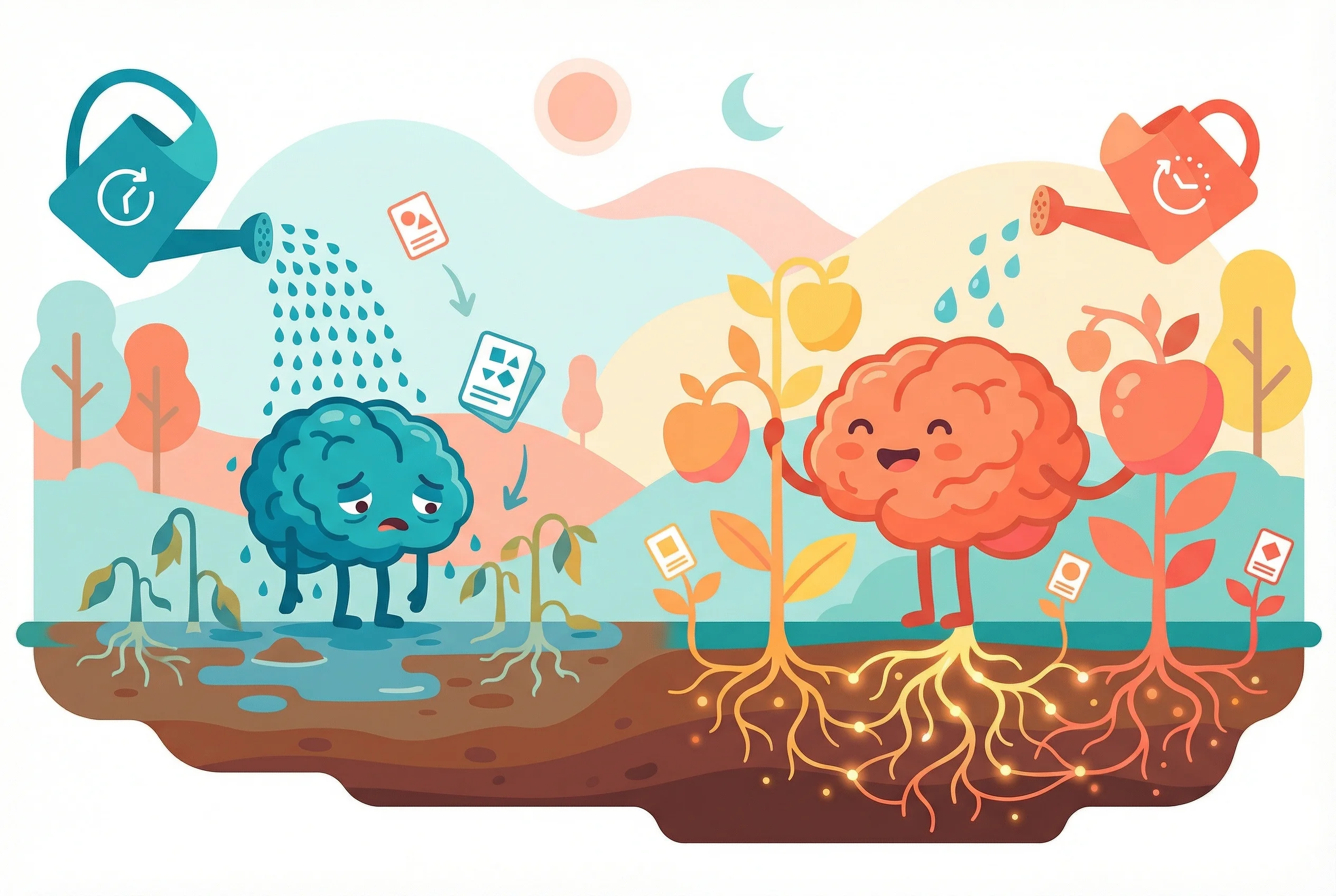
The best flashcard apps are great when you already know what you need to remember. That is the key. A flashcard is not a curiosity engine by itself; it is a retrieval machine. It brings chosen material back at the right time. The more interesting question is what should happen before the card exists: how do you find the fact, question, or little mystery worth remembering in the first place?
TL;DR
The best flashcard apps depend on the memory job. Anki is the power-user spaced-repetition tool; Quizlet is the polished mainstream deck platform; RemNote combines notes and cards; Brainscape uses confidence-rated cards; Cram and Knowt are strong free-start options; Mochi is a clean markdown-based alternative. MillionWhys is not a flashcard app, and that is the point: it is for daily curiosity before material has become a deck.
Short answer: choose Anki for maximum spaced-repetition control, Quizlet for easy shared sets, RemNote for notes-to-cards, Brainscape for guided confidence ratings, Cram or Knowt for free flashcard workflows, Mochi for markdown/offline simplicity, and MillionWhys when the goal is not memorizing a deck but discovering one satisfying question at a time.

Curious? Try one 👇
Why is the sky blue?
Jump into the daily quiz →The first fork: recall tool or curiosity tool?
Most flashcard comparisons skip the uncomfortable part: flashcards work best after someone has already decided what matters. That is perfect for vocabulary, anatomy terms, formulas, historical dates, certifications, and exam material. It is less perfect for the adult who opens a phone in a 30-second gap and thinks, "teach me something I did not know I wanted to know."
That distinction is why MillionWhys appears in this comparison honestly, not as a fake flashcard clone. If you need spaced repetition for a known deck, use a real flashcard app. If you need a daily curiosity loop that starts from questions, use a question-first app. The two jobs can support each other, but they are not interchangeable.
The curiosity science behind this is useful. Information-gap theory says curiosity rises when you can feel the gap between what you know and what you almost know. Flashcards are excellent at closing known gaps. MillionWhys is built to surface the gaps you had not noticed yet, close one cleanly, and make the next one visible.
The quick comparison
| App | Best for | Pricing snapshot | Fit |
|---|---|---|---|
| Anki | Power-user spaced repetition | Desktop/AnkiWeb/AnkiDroid free; AnkiMobile iOS $24.99 | Best if you want control |
| Quizlet | Shared sets and polished study modes | Plus $2.99/month billed yearly; Plus Unlimited $3.75/month billed yearly | Best mainstream deck library |
| RemNote | Notes, PDFs, and flashcards together | Free; Pro annual $96 and Pro+AI annual $120 shown in page data | Best if cards come from notes |
| Brainscape | Confidence-rated flashcards | Pro shown at $7.99/month billed yearly | Best guided SRS feel |
| Cram | Simple free flashcards | Free creation and study modes | Best low-friction free start |
| Knowt | Free Quizlet-style study modes plus AI | Free basic; Ultra annual $12.49/month billed $149.99 | Best for free Learn-style features |
| Mochi | Markdown notes and offline cards | Free forever tier; paid Pro for sync/features | Best minimalist personal system |
| MillionWhys | Daily curiosity before deck-building | Free to start | Best when you want one new why |
Best power-user choice: Anki
Anki is still the app to beat when you care about spaced repetition more than polish. The official AnkiMobile App Store listing describes it as a companion to the free, multi-platform, open-source Anki ecosystem and lists the iOS app at $24.99 (AnkiMobile on the App Store). That price is the part people notice, but the deeper point is control: deck structure, card templates, scheduling, add-ons, and a large community of shared decks.
Anki is not frictionless. That is a feature and a problem. It rewards people who are willing to maintain a system and understand why retrieval practice works. It is excellent for medical school, languages, technical certifications, and any domain where the material is stable enough to be card-shaped. It is less good if you mostly want an inviting daily spark.

Best mainstream deck platform: Quizlet
Quizlet is the mainstream answer because it is easy to search, easy to share, and easy to explain. Its upgrade page currently lists Quizlet Plus at $2.99/month billed at $35.99/year and Quizlet Plus Unlimited at $3.75/month billed at $44.99/year (Quizlet upgrade page). The appeal is not just price; it is the huge amount of user-created material and the low setup cost.
The honest caveat is that Quizlet is strongest when the material is already known: terms, definitions, practice tests, and sets someone has made. That is useful. It just is not the same as following your own curiosity into a new corner of the world. Quizlet helps you remember a chosen thing. A curiosity app helps you choose better things to wonder about.
Best notes-to-cards system: RemNote
RemNote is for people who do not want cards floating separately from notes. Its pricing page is titled around Free, Pro, and EDU plans, and its embedded structured data lists a Free offer, Pro monthly and annual plans, and Pro with AI monthly and annual plans, with annual Pro shown at $96 and annual Pro with AI shown at $120 at the time checked (RemNote pricing). Its own page positions the product around notes, flashcards, PDF workflows, AI cards, and spaced repetition.
That makes RemNote a strong choice if your learning starts in documents. You read a PDF, take notes, turn concepts into cards, and review. It is more integrated than a plain deck app. The tradeoff is that it still assumes you are inside a study workflow. For a curious adult with no document open, the starting question is different.

Best confidence-rated flashcards: Brainscape
Brainscape makes the learning interaction a little more explicit: after seeing an answer, you rate how well you knew it, and the system uses that confidence signal. Its pricing page lists an individual Pro plan at $7.99/month when billed yearly and says Pro adds AI-created unlimited flashcards, unlimited certified and user-made content, images and sounds, private content, bookmarked cards, reverse cards, and stat resets (Brainscape pricing).
That is a good fit when you want a more guided version of spaced repetition without building Anki infrastructure yourself. It is still in the flashcard family: chosen material, repeated over time, with retention as the success metric. If you like the feeling of confidence calibration, Brainscape is worth comparing seriously.

Best free-start options: Cram, Knowt, and Mochi
Cram is the plainest free-start option. Its homepage says users can create, study, and share flashcards for free, with modes including spaced repetition, learn, test, cram, and games, and it says its mobile app carries more than 190 million flashcards (Cram homepage). That makes it useful when you want a simple flashcard workflow without paying before you know whether you will stick with it.
Knowt is the more aggressive Quizlet-alternative option. Its plans page lists a Basic free plan for notes and flashcards, free study modes, custom hints, multiple-choice options, and browsing millions of notes and flashcards; Ultra annual is shown at $12.49/month billed upfront at $149.99 (Knowt plans). It is aimed squarely at people who want AI study tools and free Learn-style modes.
Mochi is the minimalist personal-system pick. Its homepage lists a free forever tier at $0 with no sign-up required and unlimited offline usage, plus a Pro tier for sync and additional features (Mochi pricing). It is especially appealing if you like markdown, local-first simplicity, and building your own knowledge system quietly.

Where MillionWhys fits without pretending to be a flashcard app
MillionWhys starts before the flashcard. A flashcard asks, "Can you retrieve this?" MillionWhys asks, "What tiny gap can we make visible right now?" In 10 seconds, you see a question, make a prediction, and read a fact-checked explanation. That gives the closure flashcards often assume but do not always create.
The positioning matters because many learning tools quietly become guilt machines. Streaks, decks due, and unfinished courses can help disciplined learners, but they can also turn curiosity into a chore. MillionWhys is built around the opposite bet: curiosity, not guilt; 10 seconds, not 10 minutes; emergent curriculum, not a fixed catalog. The question pool grows from what people actually wonder about, not only what a course designer decided to include.
That does not make flashcards obsolete. It gives them a neighbor. Use flashcards when you have a known body of material to retain. Use MillionWhys when you want your idle moments to keep feeding the raw material of curiosity.
What people usually miss
The hidden question behind "best flashcard apps" is not only "what helps me remember?" It is "what deserves a card?" A perfect spaced-repetition system can still become a treadmill if the material is dull, disconnected, or selected only because a syllabus said so.
Curiosity solves the upstream problem. It gives memory something alive to hold onto. A weird question about why birds fly in V formations, why coffee smells stronger than it tastes, or why a rainbow is curved is easier to remember because the mind had a gap first. Closure makes the fact feel earned. That is why a curiosity habit and a flashcard system can work together: one discovers; the other retains.
Related videos
How To Use Anki Like A Pro: Full Step-By-Step Walkthrough
RemNote Tutorial: Basic Flashcards
FAQ
What is the best flashcard app overall?
Anki is the best overall pick for power users who want control over spaced repetition. Quizlet is easier for mainstream shared sets, while RemNote and Brainscape are better if you want a more guided interface.
What is the best free flashcard app?
Anki is free on desktop, AnkiWeb, and Android through AnkiDroid; Cram and Knowt both offer strong free-start workflows; Mochi has a free forever offline tier. The best free choice depends on whether you want power, simplicity, or shared content.
Is Quizlet better than Anki?
Quizlet is usually easier and more polished. Anki is usually more powerful and customizable. If you want shared sets fast, start with Quizlet; if you want long-term control over a serious retention system, use Anki.
Do flashcard apps actually help you learn?
Yes, when the material is appropriate for active recall and repeated review. They are weaker when the real problem is curiosity, understanding, or choosing what is worth learning in the first place.
What does this have to do with AIgneous Million Whys?
MillionWhys handles the moment before a flashcard exists. It turns idle time into one small information gap, gives you real closure, and lets those tiny questions compound into a broader curiosity map.
Keep reading
Sources
Curious? Try one 👇
Why is the sky blue?
Jump into the daily quiz →Keep Exploring


Related Posts
Free Flashcard App: What It Can and Can't Teach
Looking for a free flashcard app? Compare Anki, Knowt, Brainscape, and MillionWhys for memory, spaced repetition, and curiosity-first learning.
Free Quizlet Alternatives and Apps Like Quizlet, Compared
Free Quizlet alternatives and apps like Quizlet, compared: Anki, Knowt, RemNote, Brainscape, and Million Whys — matched to the job Quizlet was doing for you.
Best Quiz Apps for Adults: Curiosity Beats Cramming
Best quiz apps for adults should feed curiosity, not homework guilt. Compare MillionWhys, Brilliant, Elevate, Quizlet, Kahoot, Vaia, Brainscape, and Deepstash.