

Why Nanjing’s 600-Year City Wall Has the Maker’s Name on Every Brick
If you walk along the south face of Zhonghua Gate in Nanjing today, then crouch and look at any brick at eye level, there is a roughly one-in-three chance you will read a person's name. Chinese characters, carved 600 years ago, naming the kiln supervisor, the foreman, the master craftsman, sometimes the individual who packed the clay. The brick is dated 1369. The person whose name is on it has been dead for six centuries, but their reputation is still load-bearing the wall around the old city.
This is the part of Nanjing's Ming-era wall that gets less attention than its scale, and it shouldn't. The wall itself is a record-holder — at 35.267 km, it is the longest masonry city wall ever built and still the longest still standing — but the more interesting story is engineered into the bricks themselves: a multi-level supplier traceability system running across an empire of kilns, formalized 500 years before the modern industrial concept of "quality assurance" had a name.
TL;DR
Nanjing's Ming city wall (1366–1386) is the longest masonry city wall ever built — 35.267 km, still 25 km standing, enclosing 55 km² with about 350 million bricks. Three things make it more interesting than its size: every brick was stamped with up to 11 levels of names so defective bricks could be traced back to a specific worker; the mortar used cooked sticky-rice water as a binder, which modern materials science (Zhejiang University, 2010) showed inhibits calcium-carbonate crystal growth and produces a near-concrete strength; and the wall broke a 2,000-year Chinese tradition of square city walls by following mountains and rivers, treating terrain as the first line of defense. By contrast, the largest European medieval walls — Carcassonne (3 km), Ávila (2.5 km), the Theodosian Walls of Constantinople (5.7 km) — were ten times shorter and built around a different idea: protect a citadel, not an entire city.
Curious? Try one 👇
Why is the sky blue?
Jump into the daily quiz →The Short Answer
Nanjing's wall is not just bigger than Europe's medieval walls; it is doing a different job, with different engineering and a different management system behind it. European walls are citadel logic — fortify the elite stronghold, let the surrounding town fend for itself if necessary. Chinese walls are city logic — enclose the entire population and economy, then make the perimeter last centuries through governance, materials science, and terrain.
The Brick Accountability System: The World's Earliest Industrial Traceability
The Ming court had a problem. The wall around the new capital needed roughly 350 million fired bricks, supplied by hundreds of kilns spread across what is now Jiangsu, Anhui, Hubei, Hunan, and Jiangxi provinces. No central inspector could possibly check each one. Bad bricks would be hidden in the middle courses where no one would notice — until decades later, when a section collapsed during a siege.
The solution was the "materials bear the craftsman's name" responsibility system (物勒工名). Before firing, each brick was stamped with a chain of names — up to 11 levels deep:

- The prefecture and county that supplied the brick
- The official in charge of brick production for that jurisdiction (提调官)
- The kiln supervisor (司吏)
- The general manager of the brickworks (总甲)
- The brick-firing foreman (甲首)
- The individual master craftsman who shaped the brick (窑匠)
- Subordinate workers and clay-pickers, in some variants
The implication was unambiguous: if your brick failed inspection, the punishment chain ran from the worker upward, but also from the official downward. Both the laborer and the bureaucrat had skin in the game. According to historians of the wall, only highest-grade bricks passed final inspection, and rejected ones can still be found buried in foundation layers — evidence that the audit actually happened.

This is, in essence, a working supplier scorecard plus traceability database running on stamped clay rather than software. The European medieval equivalent — masons' marks on cathedral stones — identified the workshop for payment purposes but did not encode the multi-level accountability hierarchy. Modern industrial quality systems (ISO 9001's "traceability of product" clauses, automotive part lot codes) reproduce the same logic with less elegance and more paperwork.
The Sticky-Rice Mortar: Pre-Modern Composite Materials Science
Bricks alone do not make a 14-meter-thick wall stand for 600 years through floods, earthquakes, and a Japanese siege. The bonding material does, and Nanjing's mortar is unusual: lime, water, tung oil, and the boiled-down water from cooking glutinous rice.
For centuries this was treated as folklore. In 2010, Bingjian Zhang and colleagues at Zhejiang University ran chemical analysis and scanning electron microscopy on samples of the original mortar from Ming-era walls, including Nanjing's. They found that the amylopectin in the rice — a branched starch — acts as a crystal-growth inhibitor. Pure lime mortar grows large, brittle calcium-carbonate crystals as it cures. With amylopectin present, the crystals stay small and pack into a dense, water-resistant matrix. The result is closer to a primitive composite than a traditional mortar — organic polymer matrix reinforcing an inorganic mineral phase.
The team's published comparisons showed the sticky-rice mortar outperformed pure lime mortar on compressive strength, water resistance, and dimensional stability. It is, by Zhang's description, "probably the world's first composite mortar." The technique appears around 1,500 years ago and reaches industrial scale during the Ming. Portland cement, by contrast, is barely 200 years old.
Terrain as Defense: Breaking the Square-City Tradition

For roughly 2,000 years before Nanjing, Chinese capital city walls followed a near-religious template laid down in the Kaogongji (考工记, ~5th century BCE): square, nine li to a side, three gates per face, a 9-by-9 grid of streets inside. Chang'an under the Tang, Beijing under the Ming and Qing — all hewed close to this geometry. Symmetry was not aesthetic; it was political, encoding the cosmological square-earth idea and the centrality of the emperor.
Zhu Yuanzhang, the founding Ming emperor, broke the template. The Nanjing wall is famously gourd-shaped, not square. Modern surveyors have measured it bending around Zijin Mountain to the east, hugging the Qinhuai River, looping wide to swallow the Xuanwu Lake basin. The decision was tactical: by "taking the advantage of mountains and rivers, occupying the dominance of lakes and waterways" (得山川之利,控江湖之势), the wall used the surrounding geography itself as the first line of defense. Attackers could not simply mass on flat ground outside any wall face — they would have to cross water or climb mountain before they reached masonry.

This is a quiet but radical shift in defensive doctrine. Roman and European tradition gridded the city first, then drew the wall around the grid. Ming Nanjing surveyed the terrain first, then drew the wall around the terrain, then let the city interior conform. It is a closer cousin to modern military engineering — fortify what nature already gives you — than to medieval European wall-building.
Zhonghua Gate: The Most Complex Surviving City Gate on Earth

If a single structure shows the difference in defensive philosophy, it is Zhonghua Gate (中华门, originally Jubao Gate 聚宝门), the wall's southern entrance and the most elaborate surviving city gate in the world. The gate complex measures 118.5 m east-to-west by 128 m north-to-south, ramparts 20.45 m tall, total area 15,168 m². It is not a gate; it is a fortress with a gate inside it.
The structure uses a three-tiered barbican (瓮城, "urn city") layout. An attacker who breached the outer arch would find themselves in a sealed courtyard surrounded on four sides by walls. Defenders dropped from above. If they breached the second arch, another sealed courtyard. Then a third. The geometry was nicknamed "the urn that catches turtles" — once inside, the attackers could not retreat under fire from above.

The complex includes 27 vaulted chambers built into the rampart walls — the cangbingdong (藏兵洞, "soldier-hiding caves") — capable of housing about 3,000 soldiers with their food, weapons, and water. Two paved horse ramps allow mounted troops to ride directly to the top of the wall. Compared to a European castle gate — typically a single portcullis with a murder hole above — Zhonghua Gate is a different category of object.
Compared to European City Walls
For perspective, here is how Nanjing's wall stacks against Europe's most famous fortified cities:
| Wall | Built | Length | Base width | Enclosed area | What it protected |
|---|---|---|---|---|---|
| Nanjing (Ming inner wall) | 1366–1386 | 35.267 km | 10–20 m | ~55 km² | Imperial capital + entire urban population |
| Theodosian Walls, Constantinople | ~408–450 CE | 5.7 km | ~5 m main wall | ~12 km² intramural | Imperial capital, three-line defense |
| Cité de Carcassonne | 3rd–13th c. | 3 km (double walls) | ~2 m | ~7 ha | Citadel, not the lower town |
| Walls of Ávila | 1090–12th c. | 2.5 km | ~3 m | ~31 ha | Old town inside, suburbs outside |
| Walls of Dubrovnik | 12th–17th c. | 1.94 km | 4–6 m landward | ~25 ha | Mercantile city-state core |
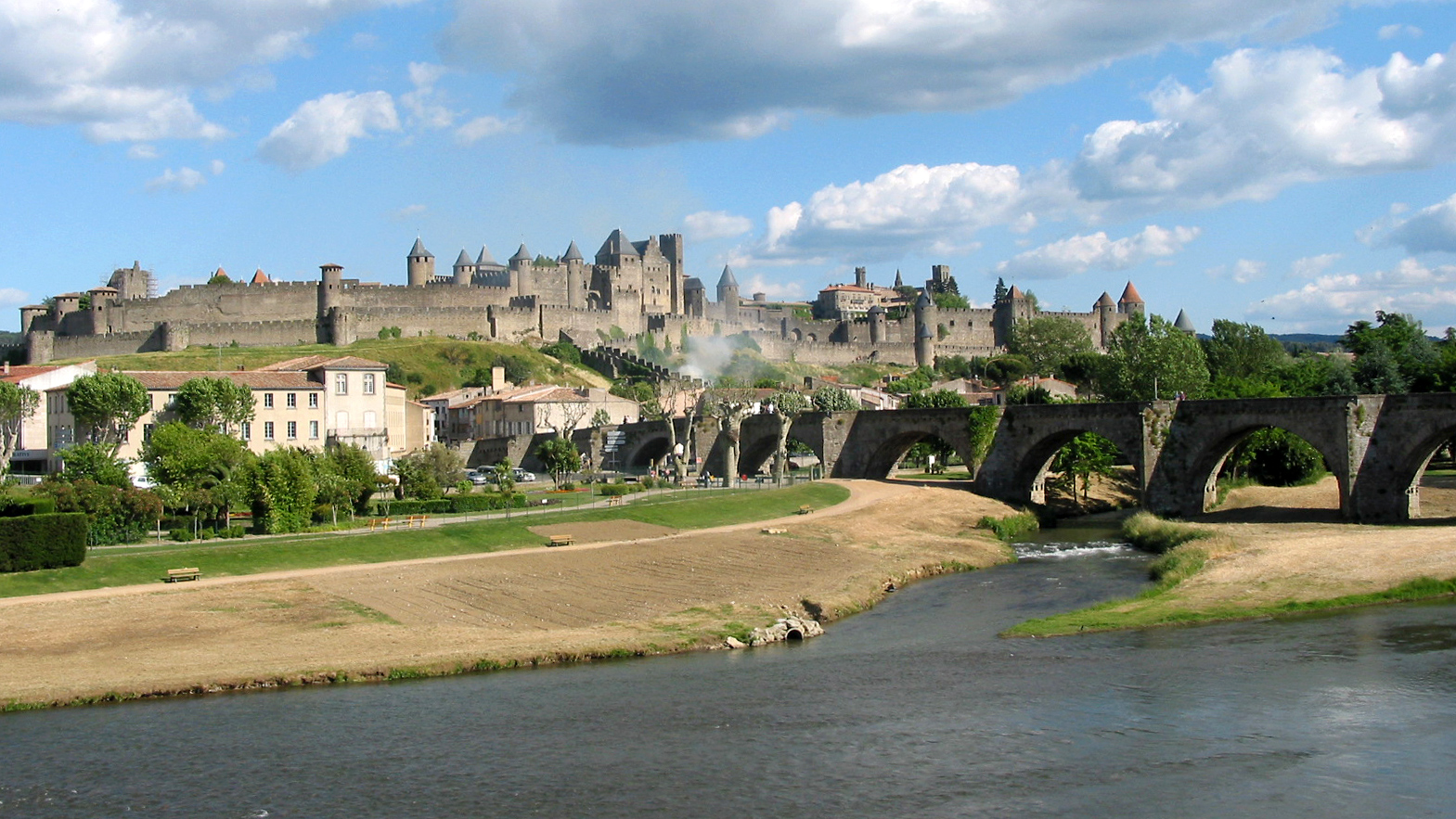
The numbers are striking but the philosophy is more striking. European medieval walls protected the citadel; Chinese imperial walls protected the city. Carcassonne's famous walls enclose only 7 hectares — about the size of a small university campus. Nanjing's wall enclosed 55 square kilometers — roughly the size of modern Manhattan below 96th Street. The Theodosian Walls, the European wall most often compared to Chinese fortification, are 5.7 km, about a sixth of Nanjing's length, and were built specifically to protect the imperial palace and core city of Constantinople from a single direction (the land approach).

The base width tells the same story. Chinese Ming-era prefectural walls were typically 10–20 m thick at the base, with a rammed-earth core faced in brick. The earth core absorbed projectile energy by deformation rather than fracture — a plausible reason why early Chinese gunpowder artillery never replaced siege ladders the way it did in Europe. European walls were typically around 2 m thick, vertical, all stone-and-mortar, and famously vulnerable to the French heavy cannon of the 1450s that ended the medieval era of warfare in months.
What People Usually Miss
The cliché lesson from comparing Chinese and European walls is "China was bigger." That misses the more interesting story: the wall is a snapshot of how the state worked.
Building Nanjing's wall in 21 years required mobilizing roughly 200,000 workers across at least five provinces, sourcing 350 million bricks from hundreds of kilns, running a multi-level inspection bureaucracy that could trace defects to individual craftsmen, and synchronizing supply chains for limestone, tung oil, granite foundations, and glutinous rice across enormous distances. This is a logistics feat the European medieval state — fragmented into feudal jurisdictions — simply could not have organized at this scale. The wall is an X-ray of centralized administrative capacity.
Conversely, the small, thick, vertical European wall is an X-ray of a different political reality: power was held by lords and merchant councils, defending compact strongholds and not large urban populations. Nobody in 14th-century France could conscript 200,000 brick-makers across a quarter of the kingdom and audit each brick. The wall couldn't get built because the state couldn't be built that way.
Both kinds of wall were structurally adequate for their threats, until they weren't. European walls fell to cannon. Chinese walls eventually fell to industrial artillery and air power. Both fell, in the end, to the next configuration of the state.
Related Watch
For a visual tour and drone footage of the Nanjing wall as it stands today, this BBC short by historian Sun Shuyun is a clean introduction: BBC: Nanjing — The Wall That Held an Empire. For the materials-science angle, the American Chemical Society's video summary of the sticky-rice mortar discovery is the original source most articles cite: ACS: Ancient Chinese Sticky Rice Mortar.
FAQ
Is the Nanjing wall part of the Great Wall?
No. The Great Wall (Changcheng) is the long northern frontier wall, built and rebuilt over 2,000 years to defend against steppe nomads. The Nanjing wall is a city wall — an enclosing perimeter for one city — built specifically as the new Ming capital's defense between 1366 and 1386 under the Hongwu Emperor. They share construction techniques (rammed earth core, brick facing) but are distinct projects.
How much of the wall is left today?
About 25.091 km of the original 35.267 km still stands, plus four of the original 13 gates (Zhonghua, Heping, Hanxi, and Qingliang). The wall is on UNESCO's tentative list as part of the joint nomination "City Walls of the Ming and Qing Dynasties," along with sections in Xi'an, Jingzhou, Xingcheng, and others.
Why is "Andy Lau" reportedly carved on a Ming brick?
Local guides and recent travel reports point out a brick whose 14th-century inscription happens to read 刘德华 — three characters that, six centuries later, became the name of the Hong Kong actor Andy Lau. It is coincidence: 刘德华 was a common given-name combination meaning roughly "Liu of virtuous flourishing." But it is also a perfect demonstration of the accountability system: the brick still names a real person from 1369, and we can still read that name today.
Is the sticky-rice mortar story actually proven, or is it folklore?
It is proven, recently. Folkloric accounts of sticky-rice in mortar go back centuries, but the chemical mechanism — amylopectin inhibiting calcium-carbonate crystal growth — was confirmed by Bingjian Zhang's group at Zhejiang University in a 2010 paper in Accounts of Chemical Research, using SEM imaging and chemical analysis on real Ming-era samples. The mortar's enhanced compressive strength and water resistance over pure lime mortar are measurable, not legendary.
Why didn't European cities build walls this big?
Mostly because they could not. Building a 35 km masonry wall enclosing 55 km² requires a unified state with the bureaucratic capacity to mobilize hundreds of thousands of workers, source materials across multiple provinces, and run a multi-level quality inspection system. Medieval Europe was politically fragmented; a city was lucky to coordinate the labor for a 3 km wall around its core. The largest exception, the Theodosian Walls of Constantinople, were built by the Eastern Roman Empire — the most centralized state in medieval Europe — and even those were only 5.7 km long.
What does this have to do with AIgneous Million Whys?
Million Whys is built on the conviction that the most interesting questions are the ones whose answers reorganize how you see the world. "Why is there a person's name carved on every brick of the Nanjing wall?" sounds like a tourist trivia question; the answer turns out to be a story about how a 14th-century state ran the world's first industrial-scale traceability system, with implications for modern supply chains and quality assurance. Each daily quiz question on Million Whys is engineered to do that small reorganization — a familiar phenomenon, a non-obvious mechanism, a payoff you can retell.
Keep reading
Sources
- City Wall of Nanjing — Wikipedia (dimensions, gate count, construction dates, mortar composition)
- Zhonghua Gate, Nanjing — Wikipedia (barbican dimensions, soldier chambers, ramps)
- Chinese city wall — Wikipedia (dimensions of Ming prefectural walls, comparison with European walls)
- Revealing the ancient Chinese secret of sticky rice mortar — ScienceDaily summary of Zhang et al., Accounts of Chemical Research, 2010
- Yang, Zhang, Liu et al., Study of sticky rice-lime mortar technology — PubMed
- UNESCO Tentative List: City Walls of the Ming and Qing Dynasties
- Walls of Constantinople — Wikipedia (Theodosian Walls dimensions and triple-line defense)
- Cité de Carcassonne — Wikipedia (3 km double-wall perimeter, 52 towers)
Curious? Try one 👇