


Why Do Magnets Attract? the Atomic Reason Explained
On this page· 11
Magnets attract because the tiny magnetic moments inside their atoms line up in grouped domains, and opposite orientations lower the energy of the system, so the pieces pull together. Those moments come mainly from electron spin, and domains are the clusters where many of them point the same way.
So why does a fridge magnet grab a plain steel door that was never a magnet? The line "opposite poles attract" never answers that. The door has no labeled north or south until the magnet shows up. If you have ever asked why do magnets attract, the gap is that skipped step, plus the habit of treating every metal as if it were iron.
The Short Answer to Why Magnets Attract
A magnet pulls because its atoms carry tiny magnetic moments created by electron spin and by electrons moving in orbit. In most materials those moments point every which way and cancel. In a magnet, or in iron sitting near a magnet, they line up so the object behaves as one magnetic piece. Opposite orientations lower the energy of the system, so the pieces pull together. Like orientations push them apart.
Three layers sit under that sentence.
- Tiny atomic magnets. Spin and orbital motion each act like a minute current, and a current makes a field with a direction.
- Domains that group them. In a few metals, huge numbers of those moments lock into regions that point roughly the same way.
- A field from outside that lines them up. A nearby magnet favors the domains that match it, so an ordinary nail becomes a temporary magnet and is pulled in.
A fridge magnet holds a steel door, and the paper note trapped against it, through that same lining-up. The steel develops a facing pole. The paper is just along for the ride.
You can repeat that paragraph at dinner and be right. Atoms first, then groups of atoms, then a field that sorts the groups. Moving charge inside the atom comes next, then the domains inside an unmagnetized nail, then the pole rule people already half-know, then the metals a magnet barely notices.
Question 1 of 6
What produces the tiny magnetic moment inside a single atom?
Atoms Are Tiny Magnets Powered by Moving Charge
People knew the pull long before anyone could name an electron. A NASA magnetism introduction traces it through more than 2,000 years: Chinese writings from around the 4th century BCE describe lodestone, naturally magnetized magnetite that attracts iron, and south-pointing devices. In 1600, William Gilbert argued from experiments that Earth itself behaves like a magnet.
A wire that moved a compass
The link to electricity arrived on a single afternoon. On 21 April 1820, Hans Christian Ørsted switched on a current in a copper wire and watched a nearby compass needle deflect, as that same NASA magnetism introduction records. Ampère, Faraday, and Maxwell later turned that observation into a full theory. A current makes a magnetic field. There is no separate stuff called "magnetic fluid."
The field around a magnet is organized electrical behavior at the atomic scale, not a mysterious fluid leaking from the metal.
Spin and orbit, in plain terms
Picture one atom as a very small loop of current, with its own arrow. Electrons moving around the nucleus are one loop. Electrons spinning are another, and quantum mechanics treats spin as a built-in property rather than a little ball twirling. In a permanent magnet, spin is the main source of the moment that survives after you take other magnets away.
Each arrow is weak. A single atom will not pin a note to a fridge. Strength shows up only when enormous numbers of arrows agree. That agreement is a later story. The atomic fact is simpler. Moving charge makes the field, and the field pushes on other moving charges and on other tiny magnets.
A moving electric arrangement can shift something nearby in everyday devices too, which is the same family of ideas behind how a touchscreen works.
A check you can run tonight
Lay a compass on a table, away from speakers and phone cases. Touch a wire from a battery to a small bulb for a second, and hold that wire near the compass while current flows. The needle should kick. No lodestone required. You have just repeated Ørsted's clue with hardware from a drawer.
Question 2 of 6
When Ørsted switched on a current in a wire near a compass, why did the needle swing away from north?
How Magnetic Domains Pull on Unmagnetized Iron
A magnetic domain is a region where large numbers of atomic moments point in roughly the same direction. An unmagnetized nail is full of them. They point in different directions, so their fields largely cancel, and the nail shows no pull of its own. Nothing is "nonmagnetic" in the atoms. The cancellation is what hides the magnetism.
A University of Melbourne magnetism teaching note puts the attraction in electromagnetic terms. Moving charges and microscopic moments make fields, and those fields push on other moments. In a permanent magnet, quantum-mechanical electron spin and orbital motion supply the moments. In ordinary iron they are already grouped into domains. Bring a magnet close and the external field encourages favorable alignment, which induces magnetization.
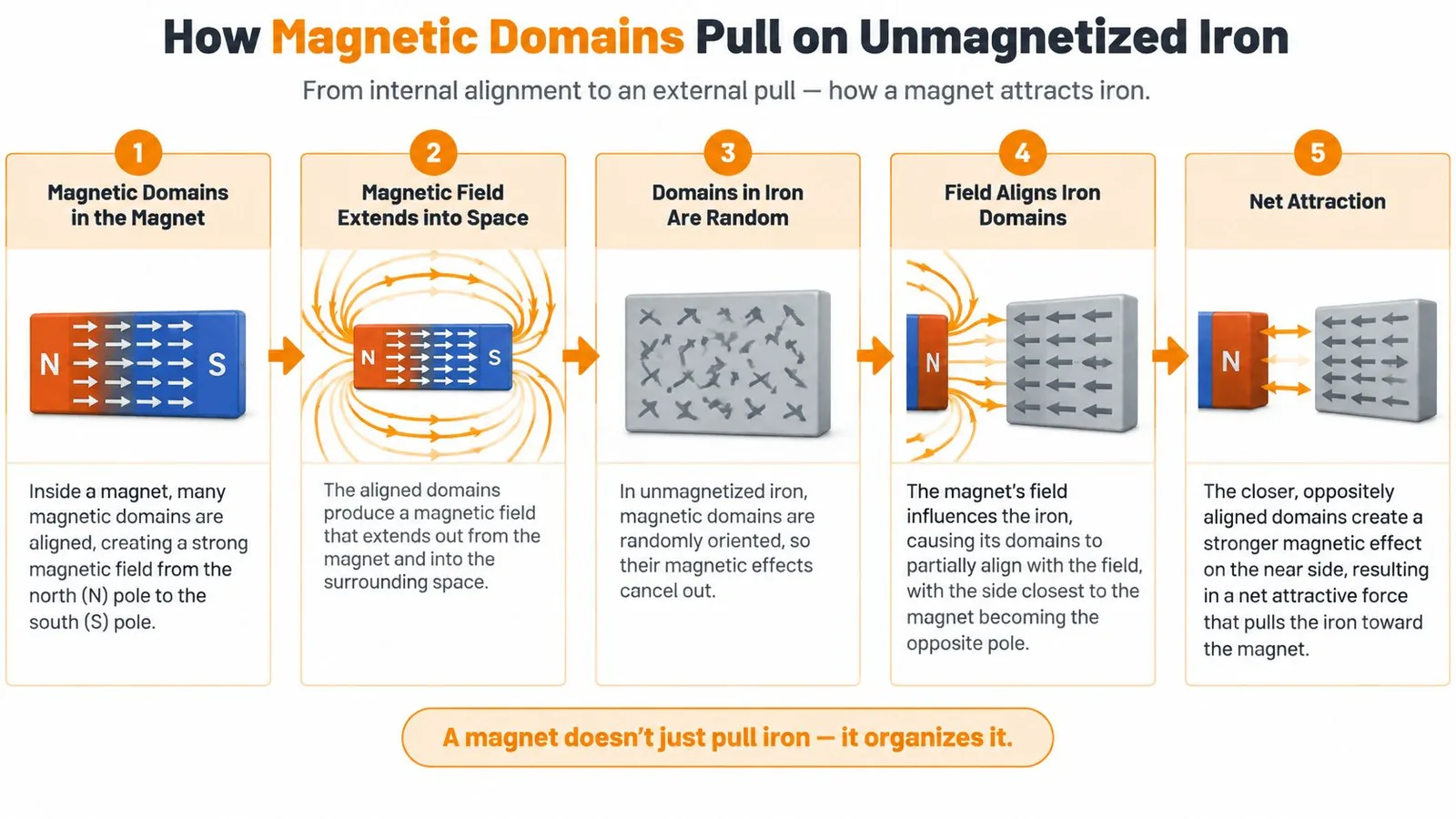
Five steps from a dull nail to a pull
- Start with cancellation. Domains in the nail point in mixed directions, so the net field is about zero. You can set the nail next to a compass and see almost nothing.
- Bring a magnet close. Its field reaches into the nail and favors domains whose arrows lie along that field. The nearer metal feels the stronger field, which is why the tip facing the magnet responds first.
- Favorable domains grow. Walls between domains shift, and some regions rotate into line. The side closest to the magnet changes the most because that is where the outside field is strongest.
- An opposite face appears. That near side becomes the effectively opposite pole, so it is pulled toward the magnet. You did not glue a pole on. The field built one.
- Take the magnet away. Domains may drift back toward a jumble, or stay partly aligned if the alloy holds magnetism well. A soft iron nail usually forgets. A hardened steel screwdriver may keep a weak pole.
Both poles of the magnet can attract that nail. North induces a facing south on the near end. South induces a facing north. Two permanent magnets are different. Like poles repel and opposite poles attract, because nothing is being rewritten inside a material that is already fully aligned.
The modern picture arrived in stages, according to that University of Melbourne magnetism teaching note. Pierre Weiss proposed molecular-field and domain ideas in 1907. Heinrich Barkhausen detected abrupt domain changes in 1919. Francis Bitter visualized domains with magnetite particles in 1931. The pull is not a mysterious tug between objects. It is a field changing microscopic magnetic order. The effect is strongest in ferromagnetic materials such as iron, nickel, and cobalt. Paper and cloth do not significantly block the field, so a magnet can lift iron through a thin nonmagnetic barrier.
Sprinkle iron filings on paper laid over a bar magnet. The grains line up along the field and bunch near the poles. You are looking at the same map that rearranged the domains inside the nail.
Question 3 of 6
Why does an ordinary unmagnetized iron nail get pulled toward a magnet if its own atomic magnets cancel out?
Opposite Poles Attract and Like Poles Repel
The classroom rule is accurate and incomplete. Opposite poles attract and like poles repel when both objects are already permanent magnets. It does not say why a magnet picks up a nail that has no pole painted on it.
OpenStax Physics flags that gap directly. Many short explanations stop at opposite poles, which leaves unmagnetized objects unexplained. In iron and other ferromagnets, domains normally point in different directions and cancel. A nearby magnet rearranges and enlarges those domains. The side closest to the magnet develops the effectively opposite pole, and attraction follows. The force is not caused by all metals being magnetic, and it does not need a pre-existing north or south on the target. That is induced magnetism, not the permanent kind.
| Pair | Result | Reason |
|---|---|---|
| North pole and south pole | Attract | Opposite orientations lower the system's energy |
| North pole and north pole | Repel | Like orientations push the pieces apart |
| South pole and south pole | Repel | Like orientations push the pieces apart |
| Magnet and unmagnetized iron nail | Attract | The field induces an opposite effective pole in the iron |
Read the last row against the first three. Two bar magnets have a choice. Flip one and the pull becomes a push. A nail does not offer that choice. Either end of the nail is attracted, because the near end is rewritten to face the magnet as its opposite. You cannot make the nail repel by turning it around.
Strength still changes with distance, and with how readily the material's domains respond. The same steel clip can snap to a strong magnet on the table and barely twitch near a weak one across the room. Permanent magnets keep their poles when you separate them. Induced poles in soft iron fade when the outside field leaves.
Practical rule: Before you test, predict what a magnet does to a nail, then check whether the pole pair or the induced face decided it.
Gravity is the other everyday pull people explain with a shortcut and then get stuck, which is why it helps to separate the rule from the mechanism in how gravity works on Earth the same way. Here the check is small. Hold a nail by the middle, bring the north pole toward one end, then toward the other. Both ends should come. Then try two magnets, north to north. That pair should push. If your prediction missed, the table above tells you which row you were in.
Question 4 of 6
Why does a bar magnet attract a plain iron nail with either of its poles, while two bar magnets repel when like poles face each other?
Which Materials Attract and Which Ignore a Magnet
People say "metal" when they mean "something a fridge magnet grabs." Those are not the same word. Strong everyday attraction belongs mainly to ferromagnetic materials, iron, nickel, cobalt, and many of their alloys. A copper pipe is metal. An aluminum can is metal. A magnet walks past both.
A Stanford solar magnetism teacher guide makes the contrast plain. Popular explanations swap "metal" and "magnetic material," even though the familiar pull is tied to ferromagnets. Other responses can be weak, temporary, or invisible unless you have sensitive instruments. The refrigerator-magnet test is a poor definition of magnetism. It mainly detects strong ferromagnetism, not every magnetic response.
| Material | Magnetic response | What a magnet does |
|---|---|---|
| Iron | Ferromagnetic | Strong attraction |
| Nickel | Ferromagnetic | Strong attraction |
| Cobalt | Ferromagnetic | Strong attraction |
| Carbon steel | Ferromagnetic iron alloy | Usually strong attraction |
| Stainless steel | Depends on alloy | Some grades attract weakly, others barely at all |
| Aluminum | Paramagnetic | Essentially no visible attraction |
| Copper | Diamagnetic | Faint repulsion, not visible without sensitive instruments |
| Paper and cloth | Non-magnetic | No effect; the field passes through |
Where the assumption breaks
Carbon steel usually snaps to a magnet because it is an iron alloy with domains that line up easily. Stainless is the trap. Some grades still respond a little. Others, especially many kitchen alloys, barely move. If one spoon sticks and the next does not, the alloy changed, not the magnet.
Aluminum is paramagnetic. Its atoms do answer a field, but the answer is so slight that a hand magnet shows nothing. Copper is diamagnetic. It is pushed, faintly, the other way, and you will not see that push without a sensitive setup. Paper and cloth do not join the argument. The field goes through them, which is why a note stays pinned.
Surveys of materials sort responses across diamagnetism, paramagnetism, ferromagnetism, and antiferromagnetism, and researchers have also reported interest in altermagnetism, a phase that mixes features associated with ferromagnetic and antiferromagnetic systems. "Magnetic" is a spectrum, not a yes or no stamped on a periodic-table box. An outside field can still induce an opposite effective pole in an initially unmagnetized ferromagnet, so the target does not have to be a permanent magnet.
An iron meteorite cube with Widmanstätten pattern is a useful object to set beside a copper coin. Meteoritic iron-nickel is the same family as the ferromagnetic rows above, and the etched crystal bands make the metal's structure visible in a way a paper clip never will.
Set out a copper coin, an aluminum can, a steel paper clip, and a small magnet. Predict each one, then test. The clip should jump. The coin and the can should sit still. If a "steel" item refuses, check whether it is a stainless grade from the table, not a failed magnet.
Question 5 of 6
Why does a magnet stick to iron nails but not to copper pennies?
Everyday Magnets and a Test to Run Yourself
Four objects on a normal day use three different mechanisms. Naming which one you are looking at stops the pole rule from doing work it cannot do.
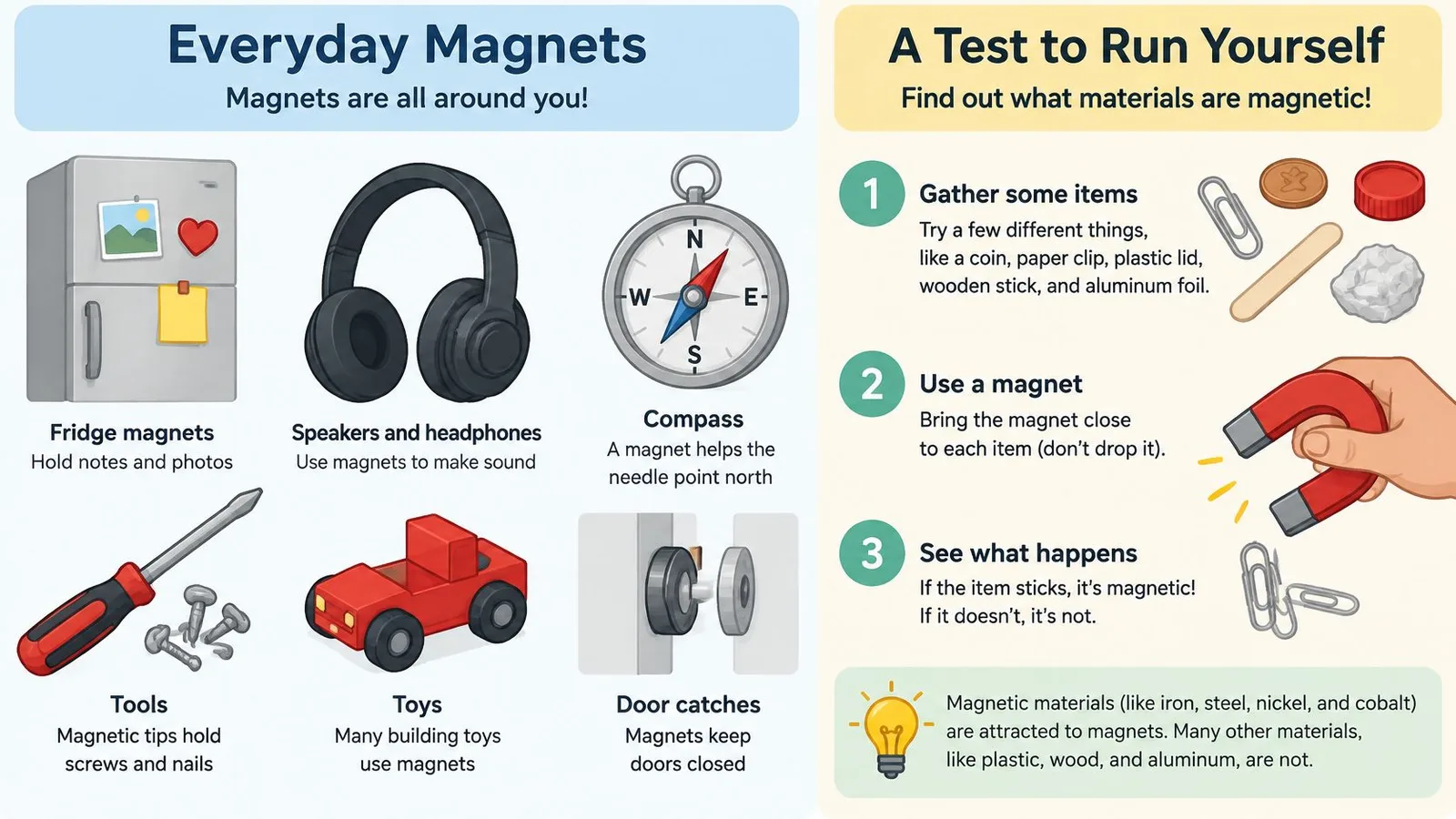
A fridge magnet and a shopping list. The magnet's field magnetizes the steel door. The door grows an induced pole facing the magnet, and that pair pulls. Label this induced magnetization. The paper note has no domains to line up. It stays put only because it is trapped between two things that do attract.
A cabinet latch. A small permanent magnet holds a steel plate on the door. The magnet keeps its pole when the door is open. The plate may be induced, or it may be a second magnet set to face the first. Label the part that keeps its pole overnight a permanent magnet. If the door is plastic with a stuck-on plate, only the plate is doing the magnetic work.
A hiking compass. The needle is a small magnet free to turn. Earth's field gives it a direction to settle into, which is why one end keeps pointing north once the case stops shaking. Label this a permanent magnet too. It is not being rewritten by the planet each morning. It is aligning a pole it already has.
A phone speaker or a toy motor. A coil carries current, that current makes a field, and the field pushes and pulls against nearby permanent magnets. Label this a current-driven field. Unplug the current and this part of the push disappears, even though the permanent magnets are still there.
A fridge magnet will not stick to a plastic bottle. Plastic has no domains for the field to sort, so there is no induced face and no pull. The same magnet fails on a glass jar for the same reason, and succeeds the moment you slip a steel lid onto that jar.
If the object has no domains that can line up, the magnet has nothing to grab, no matter how strong it feels in your hand.
Try this once this week. Put a magnet, an iron nail, a paper clip, a copper coin, and a sheet of paper on the table. Write a prediction for each before anything touches. Then test, and mark which predictions were wrong. When a new object surprises you, go back to the pole table or the material table and name the row it belongs in.
We help curious people build a daily practice of learning across fields and connecting what they discover, and our onboarding introduces Leonardo da Vinci, Benjamin Franklin, and Isaac Newton as people who worked across disciplines in exactly this spirit. Pick one object in the room, a latch, a speaker, a can, and write in your own words why it does or does not attract a magnet.
Million Whys turns spare moments into short why-questions, with a plain explanation on every answer choice, so a question like why a nail jumps and a copper coin sits still can become a daily habit rather than a one-time search. We built that practice for people who like connecting one field to another instead of collecting isolated facts. When you want the next question after this one, visit Million Whys.
Question 6 of 6
Why does a compass always point north?
Keep Exploring

Why do magnets attract iron?
Physics in Daily Life
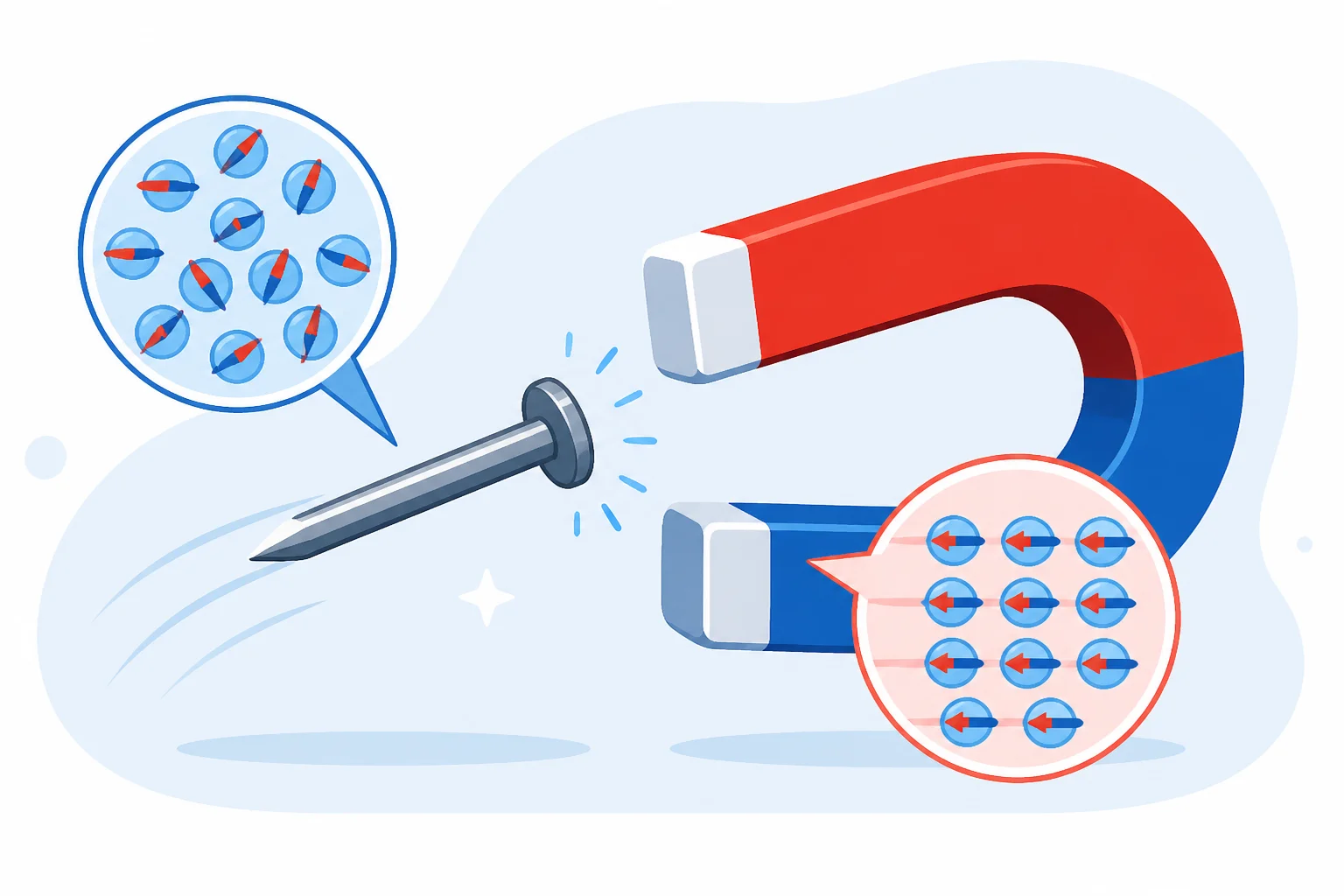
Why does an ordinary unmagnetized iron nail get pulled toward a magnet if its own atomic magnets cancel out?
Physics in Daily Life
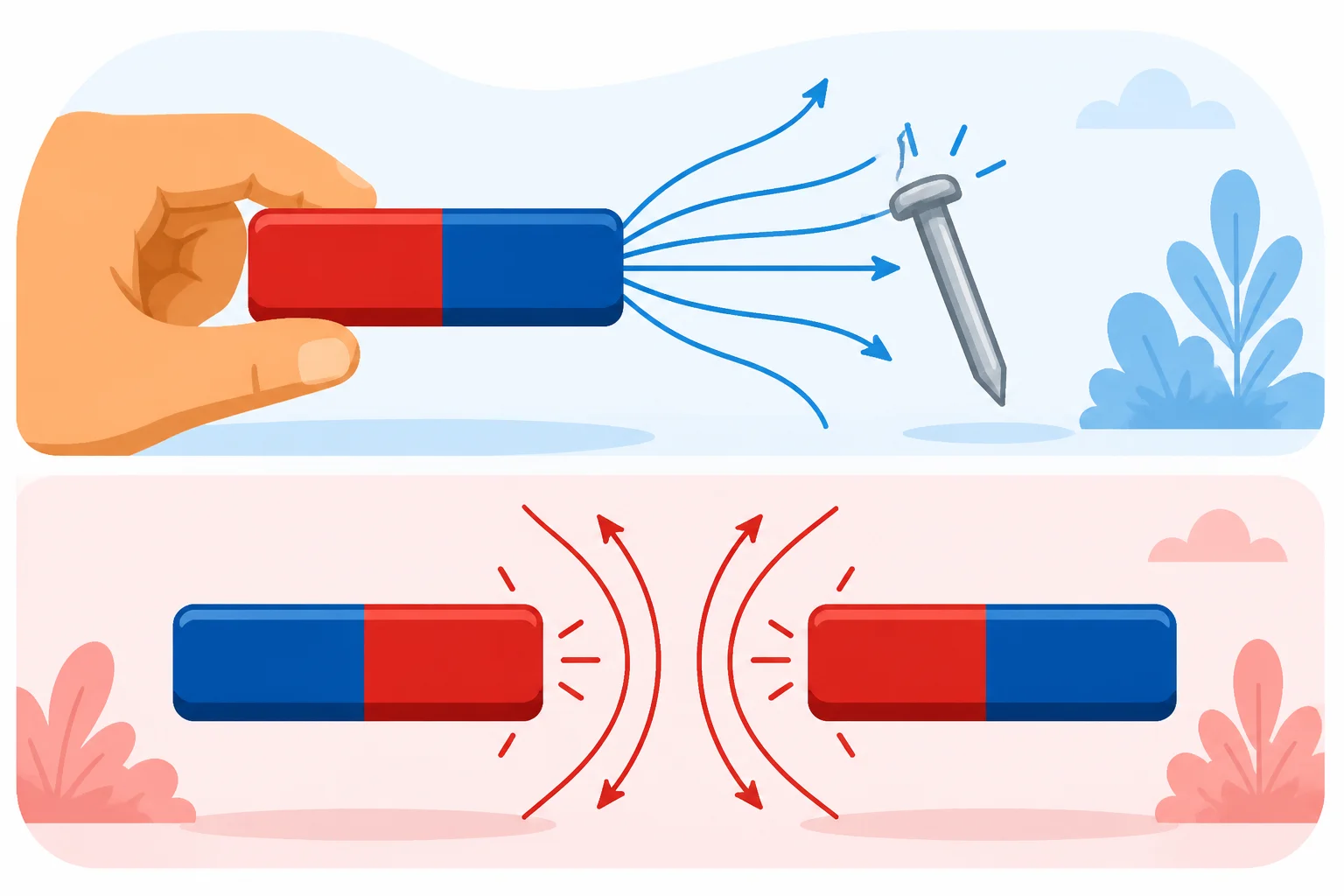
Why does a bar magnet attract a plain iron nail with either of its poles, while two bar magnets repel when like poles face each other?
Physics in Daily Life
Related Posts
How Does Gravity Work on Earth? Causes and Examples
How does gravity work on Earth? Mass, distance and the 9.8 m/s² pull explained, with everyday examples from falling objects to ocean tides.
Why Do Airplanes Fly? Lift and Wing Physics Explained
Why do airplanes fly? Wings create lift as they turn air downward, balancing weight. Learn the physics in plain language with clear examples.