

Why Is Yawning Contagious?
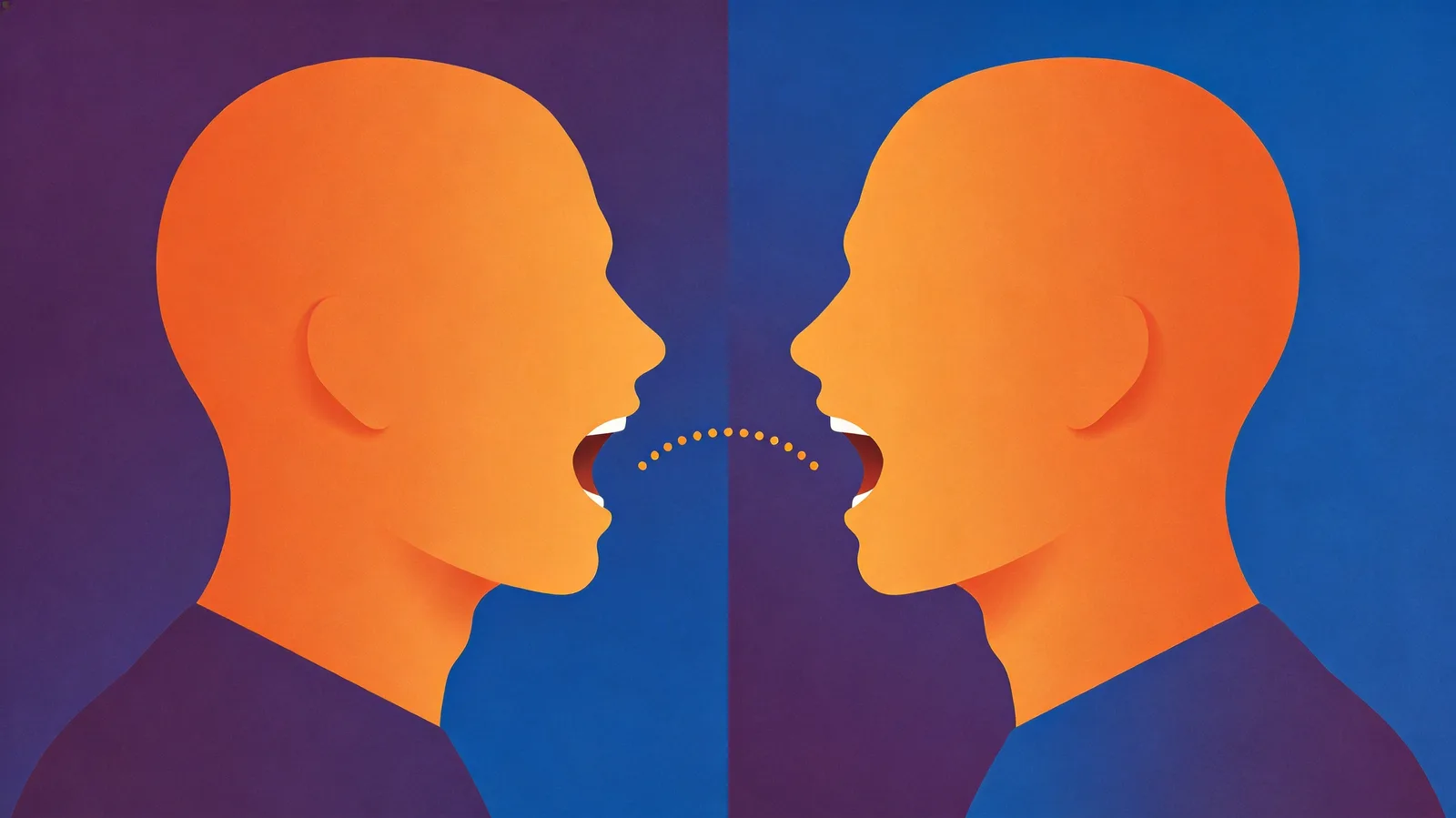
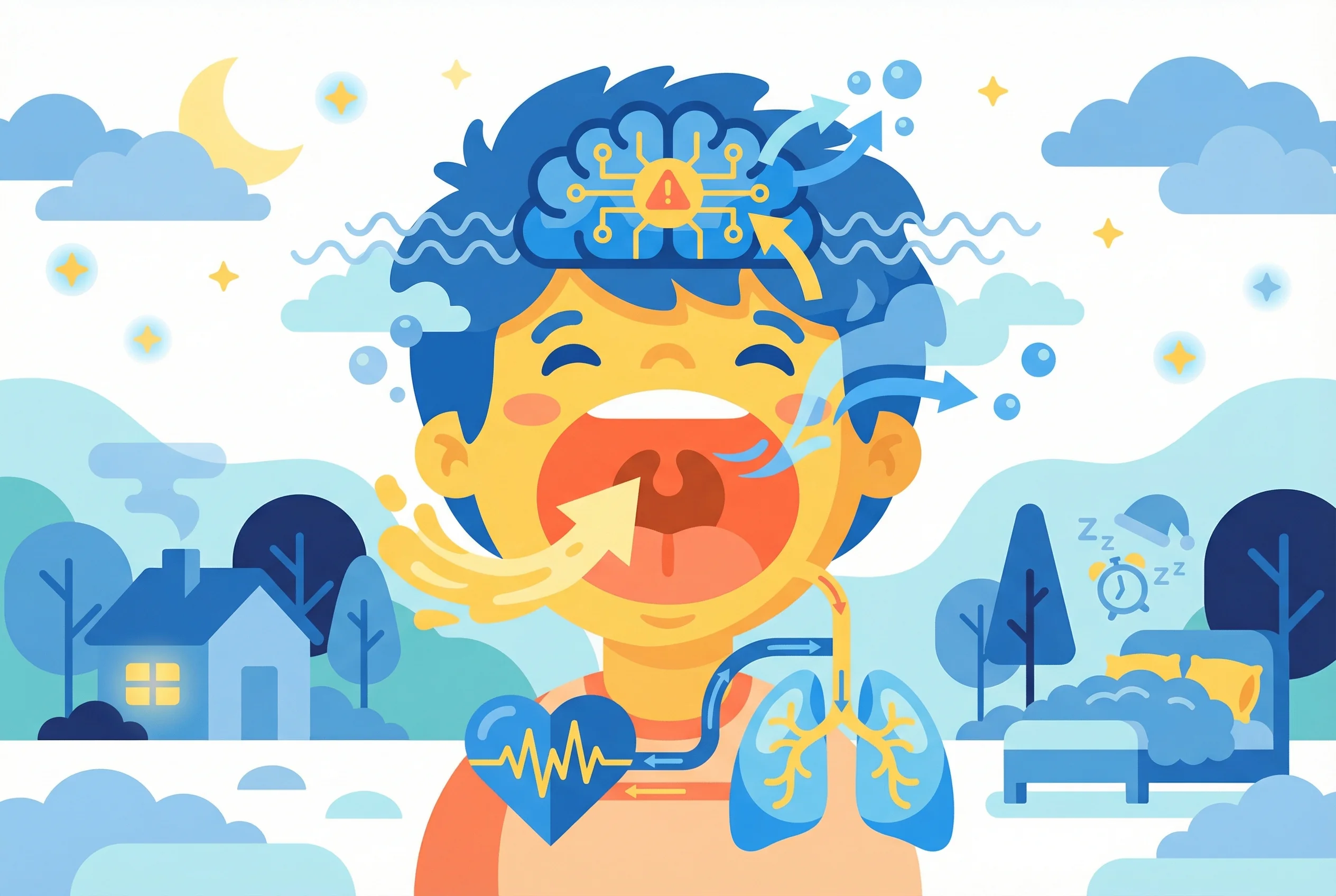
Someone across the room yawns. You notice the jaw stretch, the eyes narrow, the breath deepen—and suddenly your own mouth is opening. Even reading that sequence may have planted the urge. Why is yawning contagious? The honest answer is more interesting than the usual empathy slogan: another person's yawn can prime an automatic motor response in your brain, but scientists still disagree about why that response exists and what, if anything, social closeness adds to it.
TL;DR
Contagious yawning appears to be an involuntary action-perception response: seeing or hearing a yawn can load the motor pattern for yawning in the observer. Motor-cortex excitability predicts some individual susceptibility, while empathy findings are mixed rather than diagnostic. Brain cooling may help explain what spontaneous yawning does, but it does not by itself explain why one person's yawn triggers another.
Short answer: a perceived yawn acts like a releasing cue for a familiar motor pattern. Your nervous system represents the observed action and may tip from an urge into a yawn, especially if your motor system is susceptible at that moment. Social bond, attention, arousal, and temperature may modulate the response, but no single theory has closed the case.

Curious? Try one 👇
Why is the sky blue?
Jump into the daily quiz →First, separate two different yawning questions
"Why do we yawn?" and "why do yawns spread?" sound like one problem, but they sit at different levels. A spontaneous yawn begins without another yawn as the immediate trigger. It often appears around transitions in state—waking, tiredness, boredom, stress, or changing alertness. A contagious yawn begins after detecting a yawn or a yawn-related cue. The physical movement may look the same, but the trigger is different.
That distinction prevents a common reasoning jump. Suppose yawning helps regulate arousal or brain temperature. That could explain a benefit of the movement to the yawner. It would not automatically explain why the sight of your colleague yawning starts the same movement in you. A full account needs both a function for the act and a transmission mechanism for the cue.
Spontaneous yawning also arrives early. The 2014 Duke study by Alex Bartholomew and Elizabeth Cirulli notes that fetal yawning can be observed before birth, while contagious yawning develops later. A baby yawning therefore is not evidence of yawn contagion; it is evidence that the underlying motor program exists before the social trigger becomes reliable.

The motor system can load a yawn before you choose it
One of the clearest clues comes from a 2017 Current Biology experiment. Beverley Brown and colleagues showed yawning videos to 36 adults and used transcranial magnetic stimulation, or TMS, to measure excitability and inhibition in the primary motor cortex. Those measures predicted participants' propensity for contagious yawning and accounted for about half of the observed variation in that experiment (Brown et al., 2017).
The resistance condition was especially revealing. Telling participants not to yawn reduced full yawns but increased stifled ones. When full and stifled yawns were counted together, resistance did not remove the underlying propensity. It also increased the reported urge to yawn. In plain language, conscious control could change the yawn's outward form more easily than it could erase the motor pressure underneath.
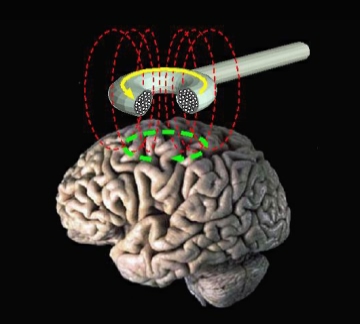
This supports an automatic-imitation account, sometimes grouped under echophenomena: observed actions can release matching actions. It does not prove that a single set of "mirror neurons" is the master switch. The paper itself notes that brain-imaging evidence for core mirror-neuron regions during contagious yawning has been mixed. "Motor resonance" is a useful description; "we found the empathy neuron" would be an invention.
The empathy story is plausible, popular, and not settled
Why did empathy become the standard answer? Several studies found patterns that look social. In a naturalistic study of 109 adults, Elisabetta Palagi and colleagues recorded hundreds of yawning bouts and reported that contagion was more likely and faster between people with closer social bonds, progressing from strangers toward friends and kin (Norscia and Palagi, 2011). Other imaging and behavioral work has implicated networks used in action observation, social processing, and emotional evaluation.
But a social pattern is not the same as a personal empathy meter. Close companions may watch one another more, share schedules and arousal states, or process familiar faces differently. Researchers also use "empathy" to mean several things, from simple emotional contagion to deliberate perspective-taking. A yawn could correlate with one part of that bundle without measuring the whole trait.
The largest direct correction in the human evidence came from Bartholomew and Cirulli's 2014 study of 328 participants. After accounting for age, their empathy measures, tiredness, time of day, and cognitive variables did not explain susceptibility. Age was statistically associated with contagion but explained only 8% of the variation; most of the stable individual difference remained unexplained (PLOS ONE). That is why "you caught my yawn, so you are empathetic" is not a scientific personality test.
Brain cooling may explain the yawn, not the contagion
The thermoregulatory hypothesis proposes that yawning helps cool the brain through changes involving jaw movement, blood flow, and inhaled air. Andrew Gallup and Omar Eldakar reviewed experiments and comparative observations that they argue support a thermal window for yawning (Gallup and Eldakar, 2013). Temperature manipulations and seasonal patterns make this a real research program, not a made-up factoid.
It is still a hypothesis, and even a correct physiological function would leave a second question open: why does seeing a yawn release the cooling or arousal movement in someone else? One proposal is group synchronization. If yawns cluster around state transitions, contagion could align alertness across social animals. Another is that an easily recognized gape simply became a strong releasing stimulus. These ideas generate testable predictions, but neither deserves to be written as settled evolutionary history.

The familiar oxygen story fares worse. A yawn includes a deep breath, but that visual resemblance does not establish that low oxygen or high carbon dioxide triggers it. Modern discussions focus more on state regulation, thermoregulation, motor control, and social synchronization. "Your brain needs more oxygen" is attractive because it closes the gap quickly; it is also too neat for the evidence.
Dogs show why one striking result is not enough
A 2008 experiment helped make dog yawning famous. Twenty-nine dogs watched a human experimenter either yawn or make control mouth movements. Twenty-one yawned in the yawning condition; none yawned in the control condition (Joly-Mascheroni, Senju, and Shepherd, 2008). The result supported contagious yawning across species and invited an empathy interpretation.

The follow-up is the more useful lesson. A 2020 Bayesian reanalysis combined trials from six dog studies into a dataset of 257 dogs. It found robust evidence that dogs yawn more in response to yawning demonstrations than controls, but no evidence for the familiarity, gender, or prosociality biases predicted by an empathy account (Neilands et al., 2020). Dogs do appear to catch yawns; the leap from contagion to empathy did not survive the larger test.
This is science doing closure properly. The second paper did not erase the first. It kept the observed phenomenon and narrowed the story attached to it. A satisfying answer does not have to be final; it has to separate what the evidence supports from what we merely want the phenomenon to mean.
What people usually miss
The overlooked fact is not that yawning is contagious. It is that susceptibility is both variable and fairly stable within individuals. Some people respond readily to videos, sounds, descriptions, or even thoughts of yawning; others do not. That difference is not a moral score. The motor-cortex study suggests that basic excitability and inhibition matter, while the Duke study shows how little familiar questionnaire variables explain.
The second missed point is the difference between mechanism and purpose. We have evidence for how a cue can push a motor system toward a yawn. We have competing proposals for what spontaneous yawning does. We have suggestive social patterns. Those pieces can coexist without collapsing into one slogan. The best current answer is a layered one: automatic motor contagion is real; empathy may modulate some contexts; the adaptive purpose remains open.
Related videos
Why Is Yawning Contagious? — TED-Ed
FAQ
Can reading about yawning really make you yawn?
It can. Visual yawns are not the only trigger reported in experiments and observations; sounds, descriptions, and thinking about the action can also produce an urge in susceptible people. Not responding is normal too.
Does catching a yawn mean you are empathetic?
No. Some studies link contagion with social closeness, but larger work found standard empathy measures did not explain who caught yawns after age was considered. A contagious yawn is not an empathy test.
Why does resisting a yawn make the urge feel stronger?
Suppressing the movement can hold an already prepared action in check. In the 2017 motor-cortex experiment, resistance shifted full yawns toward stifled yawns and increased the reported urge without eliminating overall propensity.
Do dogs catch human yawns?
Evidence across multiple studies says yes: dogs yawn more after yawning demonstrations than after controls. The larger reanalysis did not support using that response as evidence of dog empathy.
Is yawning mainly a way to cool the brain?
Brain cooling is a serious hypothesis with experimental support, but researchers have not reached a universal consensus on yawning's primary function. It also addresses what a yawn may do, not fully why yawns spread between observers.
What does this have to do with AIgneous Million Whys?
This is what a good answer should feel like: the familiar empathy story closes one gap too quickly, while the evidence opens a better one about motor control, social cues, and animal behavior. Million Whys follows those small gaps until the closure is earned rather than merely catchy.
Keep reading
Sources
Brown et al. 2017: A Neural Basis for Contagious Yawning
Bartholomew and Cirulli 2014: Individual Variation in Contagious Yawning Susceptibility
Norscia and Palagi 2011: Yawn Contagion and Empathy in Homo sapiens
Gallup and Eldakar 2013: The Thermoregulatory Theory of Yawning
Joly-Mascheroni et al. 2008: Dogs Catch Human Yawns
Neilands et al. 2020: Contagious Yawning Is Not a Signal of Empathy in Dogs
Curious? Try one 👇
Why is the sky blue?
Jump into the daily quiz →Keep Exploring
Related Posts
Why Can't You Tickle Yourself? Brain Prediction
Why can't you tickle yourself? Your cerebellum predicts your own touch, cancels the surprise, and shows how the brain labels self-made sensation clearly.
Why Do We Get Goosebumps? The Fur Reflex Left Behind
Why do we get goosebumps? Tiny arrector pili muscles, old fur logic, emotional chills, and a useful closure loop explain the bumps on your skin.
Why Do Songs Get Stuck in Your Head?
Why do songs get stuck in your head? Earworm science explains catchy hooks, mental replay, stress, boredom, chewing gum, and practical ways to stop the loop.