
Why Can One Storm Scramble Flights Across the Whole Country?
If you have ever looked at an airport board and wondered why a thunderstorm in one city can ruin flights hundreds or even thousands of miles away, the answer is not just “weather.” The surprising part is that air travel behaves less like a collection of isolated flights and more like one giant, tightly-coupled machine. When a major hub gets jammed, the disruption does not stay local for long.

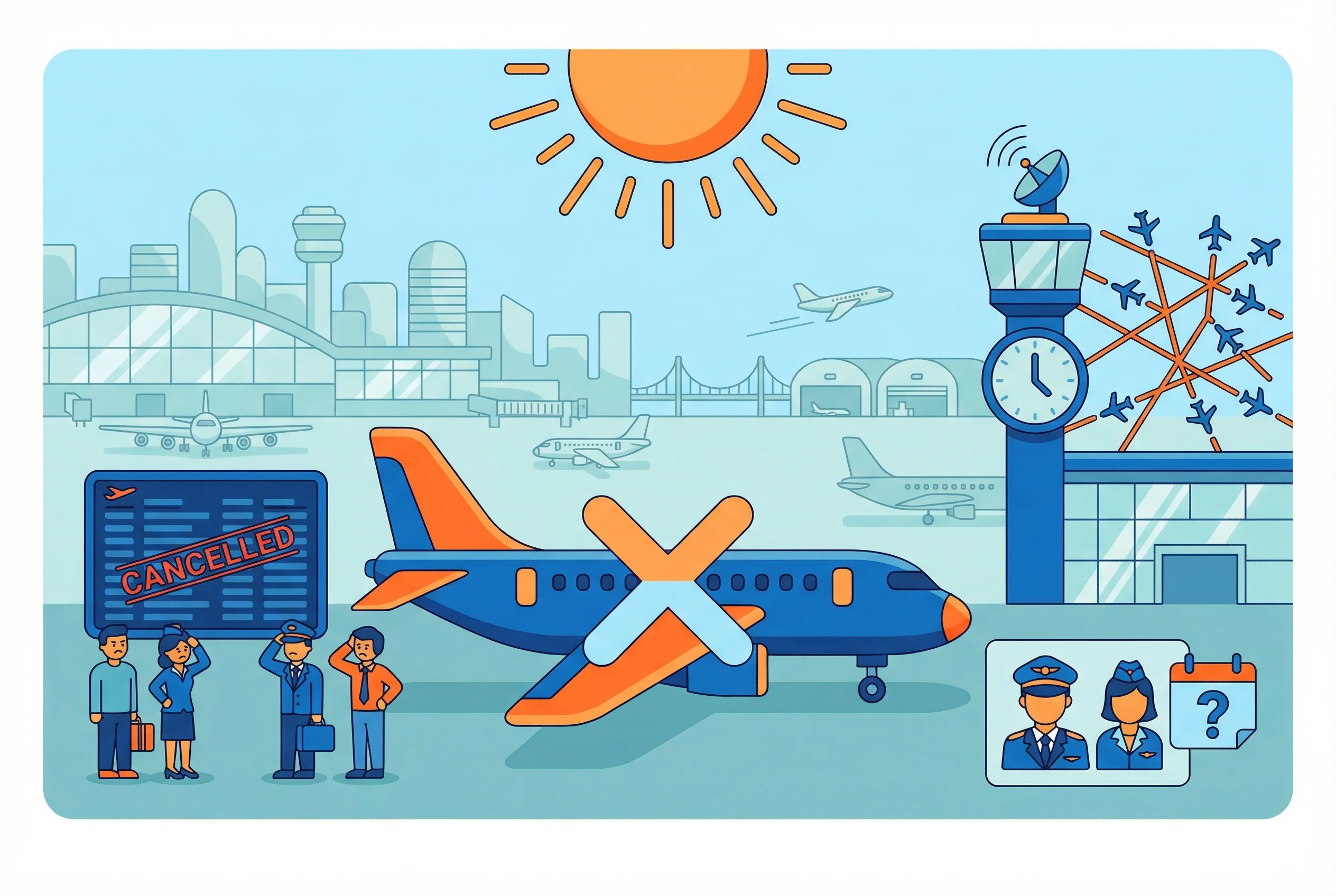
One storm can scramble flights across the whole country because airlines reuse the same planes, crews, and hub connections all day long. Once a major hub slows down, the disruption spreads through aircraft rotations, crew duty limits, missed passenger connections, and gate congestion.
This is why flight chaos often feels so unfair. Your departure airport may be sunny. Your destination may be clear. And yet your trip still gets delayed, re-timed, or canceled because the real bottleneck is somewhere upstream in the network.
In April 2026, major storms contributed to more than 12,500 flight disruptions across the United States. Reuters reported more than 2,000 cancellations in one wave and more than 8,000 disruptions in another, which makes the main lesson hard to miss: weather starts the problem, but network structure determines how far the damage spreads.

Short answer
One storm can scramble flights across the country because airlines do not operate each flight independently. Aircraft, crews, and passengers are constantly moving through connected hub networks on tight schedules, so when a key airport slows down, the knock-on effects propagate outward through the rest of the system.
Curious? Try one 👇
Why is the sky blue?
Jump into the daily quiz →What actually turns a local delay into a national one?
Think about a single airplane as part of a chain rather than a single trip. That aircraft might start the morning in Chicago, fly to Charlotte, continue to Dallas, and then finish the day in Phoenix. If storms pin it down in Charlotte for two hours, every downstream leg is now at risk. The same is true for pilots, flight attendants, gates, maintenance windows, and even passengers connecting through the same airport.
The key mechanism is network coupling: commercial aviation is built for efficiency, and efficiency means reuse. The same assets are reused all day long. That makes the system economically powerful, but it also makes it fragile when timing breaks.
The hidden role of hubs
Most major airlines do not run point-to-point networks for every route pair. They rely on hub airports to concentrate flights, swap aircraft and crews, and gather connecting passengers. That structure is efficient because it lets airlines serve many destinations without flying every city pair directly.
But the same design also creates concentration risk. If a big hub slows down, the whole airline begins to feel it. A storm over a hub is not just a local inconvenience; it is a disruption to one of the system’s switching centers.

That is why travelers often experience a weird mismatch between local conditions and system outcomes. The weather where you are may not matter as much as the weather where the network is trying to rebalance planes, crews, and connections.
Three separate chains start breaking at once
| System layer | What gets disrupted | Why it spreads |
| Aircraft rotation | The plane scheduled for your flight arrives late or not at all | That aircraft was needed on several later routes the same day |
| Crew scheduling | Pilots and cabin crew miss legal duty windows or get stranded | Even if the aircraft is available, the crew may no longer be legal to operate it |
| Passenger connections | Travelers miss onward flights, forcing rebooking and gate churn | Missed connections increase load and complexity elsewhere in the network |
People usually imagine delays as “the flight left late.” In reality, the system is juggling several interlocking constraints at once. Weather may start the problem, but the cascade comes from the way those constraints collide.
Why airlines cannot just instantly recover
A common intuition is: if airlines know there is a storm, why not simply reroute around it and keep everything moving? Sometimes they do. But recovery is limited by physical and regulatory constraints:
- Aircraft and crews are in specific places, not abstract pools.
- Pilots and cabin crew have duty-time limits for safety reasons.
- Alternative airports and gates may already be full.
- Air traffic control flow restrictions reduce how many aircraft can safely move through the same airspace.
- Reassigning one aircraft to save one route can break several others.
In other words, the system is constrained not just by weather, but by the geometry of where assets already are.

Why cancellations sometimes make more sense than more delays
To travelers, a cancellation can feel worse than a delay. But from the network’s perspective, cancellations are sometimes a form of damage control. A heavily delayed flight can keep tying up an aircraft, gate, and crew while also making downstream timing worse. Canceling one segment can sometimes free the airline to preserve more of the network.
That is why disruptions often look irrational from the passenger’s seat but coherent from the system’s seat. The airline is not only trying to save your itinerary; it is trying to prevent a broader collapse in tomorrow morning’s schedule too.
What everyone gets wrong about “bad weather” delays
The usual story is too shallow: storm happened, flights delayed. The deeper story is that weather is often only the trigger. The real reason disruption scales is that airlines run on a highly optimized but tightly linked network.
That makes this a classic “efficient system vs resilient system” tradeoff. Tight turnarounds, busy hubs, and dense reuse keep prices lower and planes fuller in normal times. But they also reduce slack when something goes wrong.
Why this matters beyond air travel
This is one of those topics that upgrades your world model because it generalizes. Flight disruptions are not just about planes. They are a visible example of how modern systems work when they are optimized for throughput:
- a local bottleneck becomes a network bottleneck,
- high efficiency reduces slack,
- and tightly connected chains transmit failure faster than people expect.
That same pattern shows up in supply chains, cloud infrastructure, ports, logistics, and even software services. A system can feel robust during normal operation and still be vulnerable to cascade failures when one critical node stalls.
Recommended watch
If you want a quick visual explanation of how airline network design works, this Wall Street Journal video is a useful companion: United vs. Southwest Airlines’ Flight Planning Strategies, Explained.
For a more direct primer on hubs themselves, this short explainer is also relevant: Hub and Spoke System in Airline Industry.
FAQ
Why do I get delayed when the weather is fine at my airport?
Because your plane, crew, or incoming connections may depend on another airport that is experiencing disruption.
Why do hubs matter so much?
Hubs concentrate flights, aircraft rotations, crews, and connecting passengers. That makes them efficient, but also makes disruption there more contagious.
Why do airlines cancel flights instead of just delaying them?
Because a cancellation can sometimes stop a delay spiral from damaging more flights later in the day.
Can airlines avoid this completely?
Not really. They can improve resilience, but a national network built for efficiency will always have some vulnerability to cascading disruption.
What does this have to do with AIgneous Million Whys?
AIgneous Million Whys is built for questions exactly like this: familiar situations that seem simple at first, but turn out to be driven by deeper systems, hidden constraints, or non-obvious mechanisms. Instead of stopping at “weather caused delays,” Million Whys tries to explain the structure underneath the chaos.
Keep reading
Sources
Curious? Try one 👇