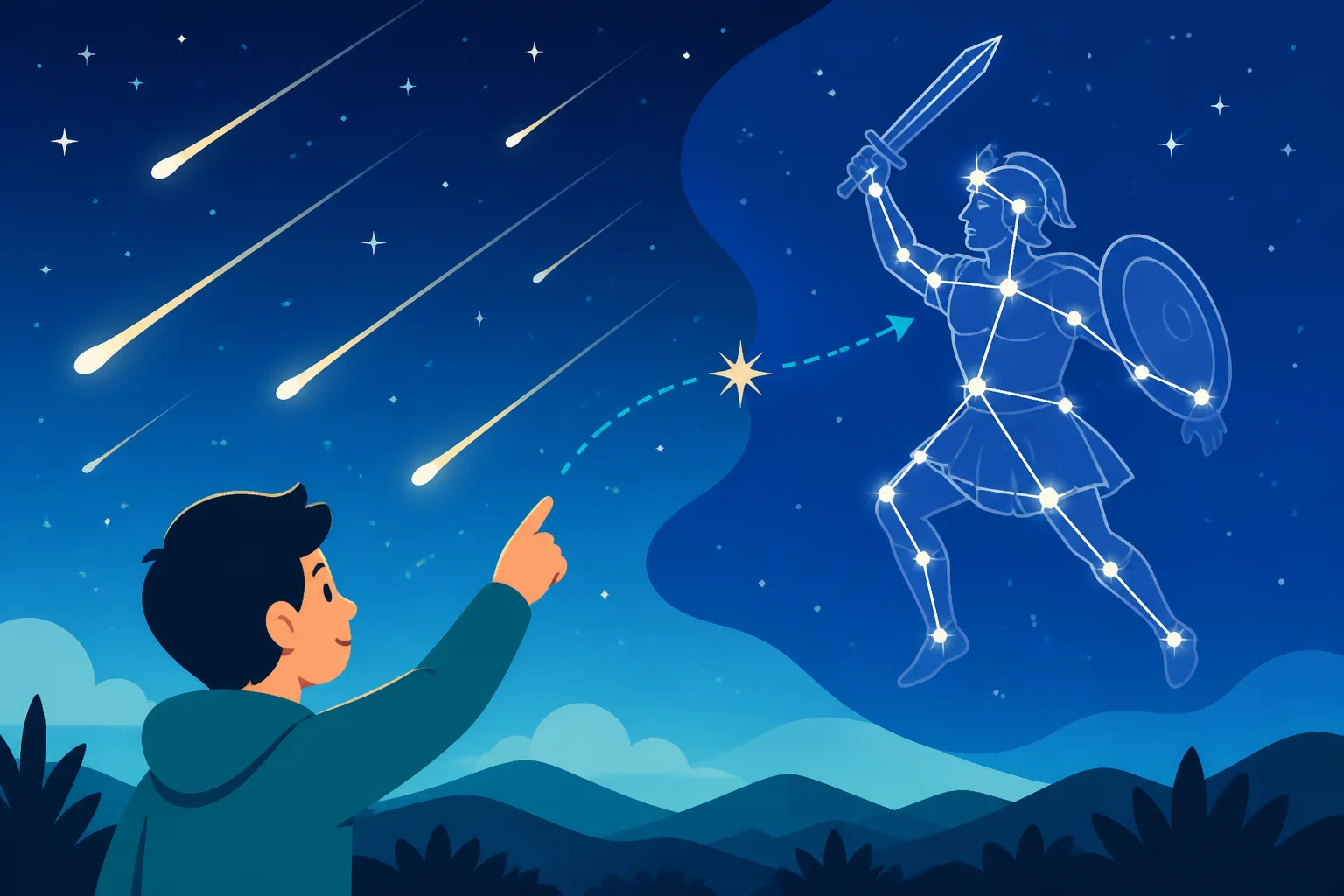

Lyrid Meteor Shower 2026: When, Where, and How to Watch the Peak
TL;DR
- Peak window: evening of April 21 into pre-dawn April 22, 2026. Global peak at 19:15 UTC on April 22.
- Rate: 10–15 meteors per hour under a dark sky, with rare historic bursts up to 100/hour.
- Moon: waxing crescent (~27% illuminated) sets shortly after midnight, leaving a moonless prime window.
- Where to look: northeast, toward the star Vega in the constellation Lyra, after it rises around 9–10 p.m. local time.
- Gear: your eyes. No telescope needed. Dark spot, warm clothes, 20 minutes to dark-adapt.
Curious? Try one 👇
Why is the sky blue?
Jump into the daily quiz →When Exactly to Watch (US Timezones)
The 2026 Lyrids peak at 19:15 UTC on April 22 — which is daytime in the Americas. So you watch the hours around the peak: the late-evening-to-pre-dawn window that brackets midnight.
| Timezone | Best viewing window |
|---|---|
| Eastern (EDT) | Midnight – 5:30 a.m., morning of April 22 |
| Central (CDT) | Midnight – 5:45 a.m., morning of April 22 |
| Mountain (MDT) | Midnight – 5:00 a.m., morning of April 22 |
| Pacific (PDT) | Midnight – 5:00 a.m., morning of April 22 |
| Alaska (AKDT) | Midnight – 4:30 a.m., morning of April 22 |
| Hawaii (HST) | 11 p.m. April 21 – 4:30 a.m. April 22 |
The radiant — the point in the sky Lyrid meteors appear to stream from — rises in the northeast around 9–10 p.m., but the show gets dramatically better after midnight, when the radiant climbs high overhead and the Earth's rotation turns you into the debris stream.

Where to Look: Vega in Lyra
Lyrid meteors appear to stream outward from a point (the radiant) near Vega, the brightest star in the summer constellation Lyra. Vega is one of the five brightest stars visible from the Northern Hemisphere — look northeast in April late evenings and you cannot miss it.
Pro tip: don't stare directly at the radiant. Meteors appear to come from that point, but they streak across a huge arc of sky. You'll see more meteors (and longer trails) if you look away from the radiant by 30–60°. Lie flat on your back, aim your feet generally east, and let your peripheral vision do the work.
How to Watch (No Telescope Needed)
The Lyrids are a naked-eye event. Binoculars and telescopes have too narrow a field of view — by the time you've swung a scope toward a meteor, it's already gone.
Conditions that matter
- Dark sky. Get away from city lights. Even a small town's light dome will wash out dim meteors. Rural, high-altitude, and coastal locations score best. Use lightpollutionmap.info to find the darkest spot you can drive to in under an hour.
- Eye adaptation. Your rod cells need roughly 20 minutes to fully dark-adapt. Keep phones off or use a red-filter app — a single glance at a white screen will reset your eyes.
- Warm clothing. You'll be lying still for an hour-plus. In most of the US, pre-dawn April temperatures can drop into the 30s°F / low single-digit °C. Bring a blanket or sleeping bag.
- Moon. 2026 is kind to you: the waxing crescent sets shortly after midnight, leaving the prime post-midnight window dark.
Northern vs. Southern Hemisphere
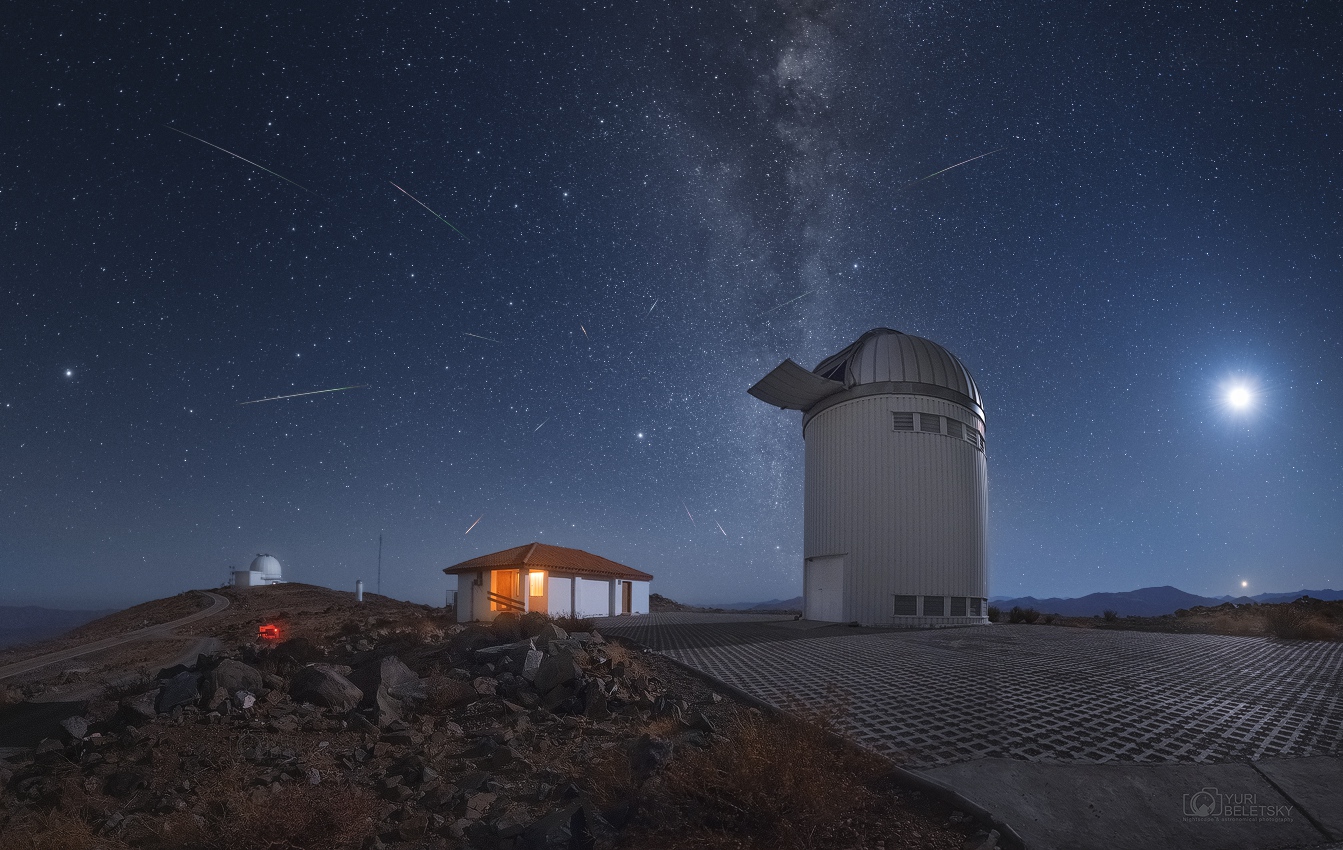
Lyrids strongly favor the Northern Hemisphere. The radiant sits near declination +34° — from Chile or Sydney it barely pokes above the northern horizon, and when a radiant stays low, most meteors either skim the atmosphere at horizon angles or get blocked by Earth on the far side. Southern-hemisphere viewers can still catch a handful of long, horizon-grazing "Earthgrazers" in the last hour before dawn, but the show is modest compared to the view from 30°–50° north.
What You'll Actually See
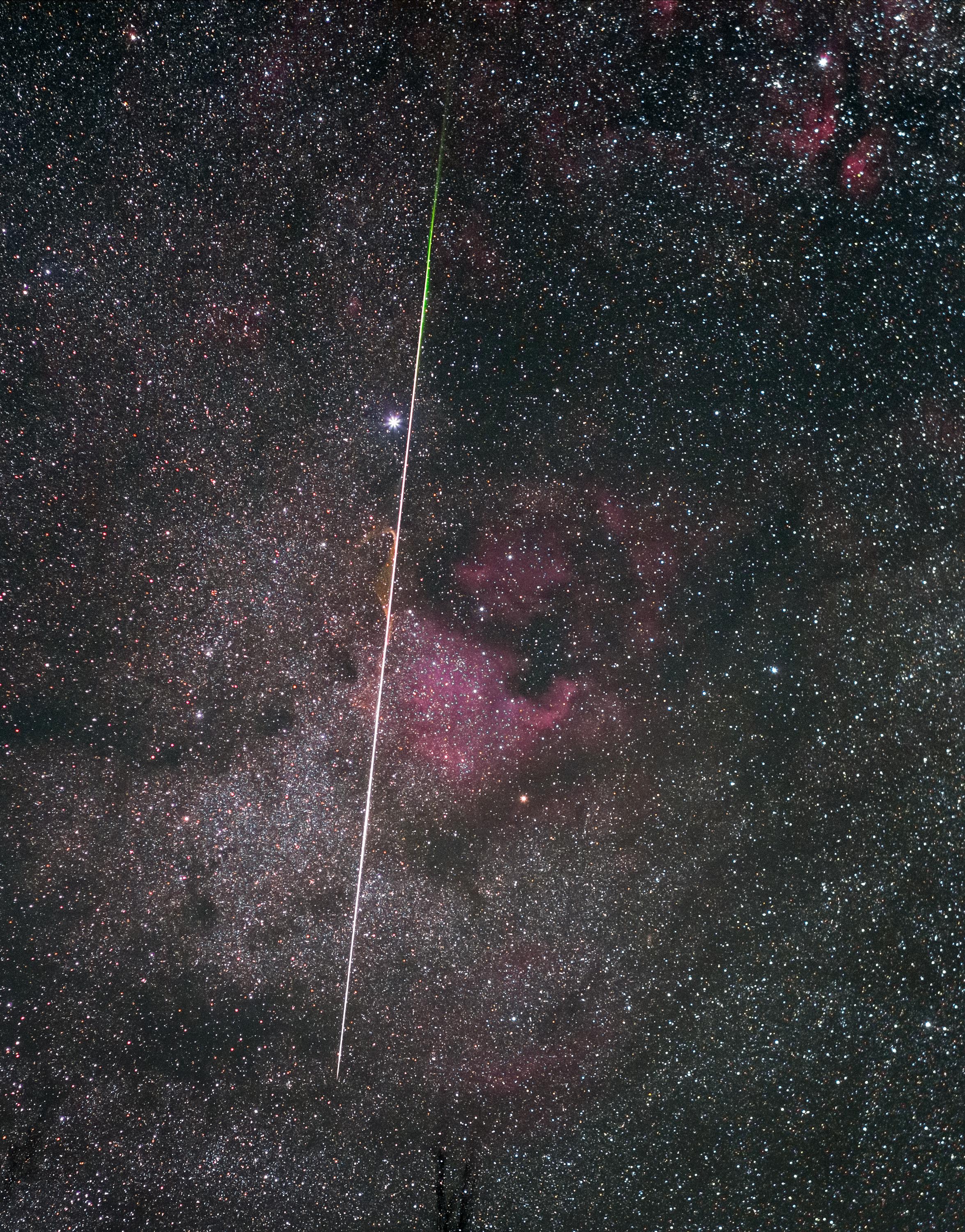
Lyrid meteors strike Earth's atmosphere at 47 kilometers per second — roughly 105,000 mph. That's fast enough to vaporize grain-of-sand-sized particles at altitudes of 80–100 km, producing the brief streak we call a shooting star.
A few Lyrid-specific things to watch for:
- Persistent trains. Brighter Lyrids leave an ionized trail that glows for several seconds after the meteor itself is gone. The 47 km/s impact speed ionizes air molecules along the flight path, and the glow fades as those ions recombine with electrons.
- Fireballs. Occasional Lyrids outshine Venus or even the Moon. These come from larger (marble-sized or bigger) fragments of Comet Thatcher.
- Bursts. The Lyrids are famous for unpredictable surges. Some years produce rates near 100 per hour (1922, 1982), far above the average 10–15/hour. Nobody has figured out how to predict these — you just have to be outside.

Why Do the Lyrids Happen at All?
Every April, Earth runs headlong into a river of dust and rock shed by a comet named C/1861 G1 Thatcher. The comet itself isn't here right now — it's a long-period visitor on a roughly 415-year orbit, last seen in 1861 and not due back until around 2278. But its debris is permanently parked along that orbit, a ghost of visits past.
The mechanism in three steps:
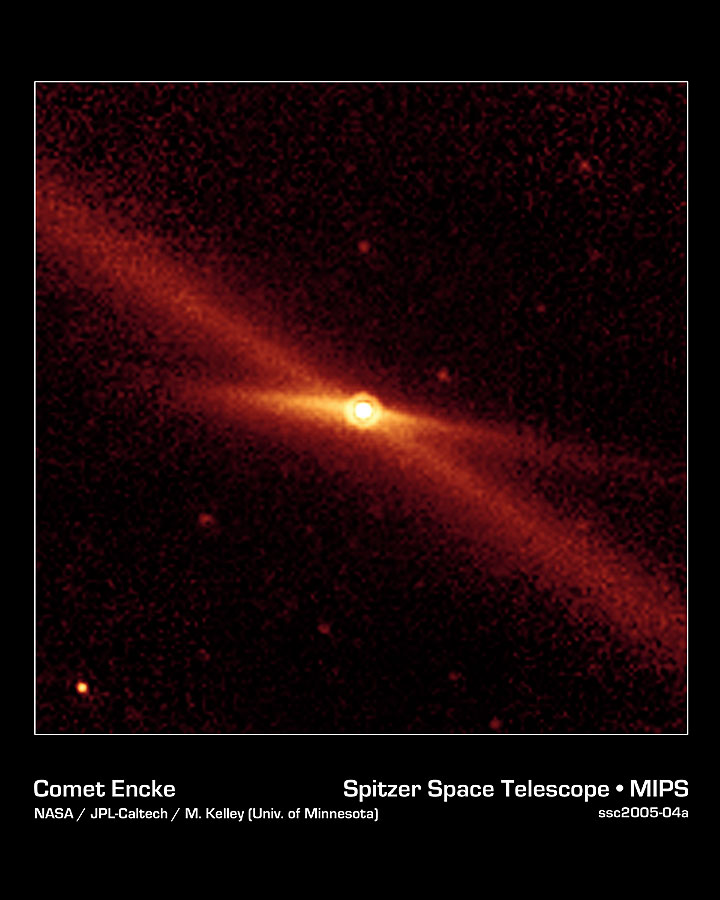
- A comet sheds material on every perihelion pass. When Thatcher swings near the Sun, solar heating vaporizes its ices, and the escaping gas drags dust and small rocks off the nucleus. Over many orbits, a long, thin ribbon of debris builds up along the comet's path.
- Earth crosses that ribbon every year in mid-April. Our orbit happens to intersect Thatcher's. Each April 21–22, we plow through the densest core of the stream at ~30 km/s orbital speed.
- The particles hit our atmosphere fast enough to glow. Combine Earth's orbital motion with the stream's motion and you get 47 km/s relative speeds. Even a dust-grain-sized particle compresses and ionizes the air in front of it, producing the 1–2 second light streak we see.
Why Meteor Showers Never "Run Out"
Here's the question nobody asks but everyone should: if Earth has been sweeping up Lyrid debris for thousands of years, why haven't we cleaned out the stream?
Three reasons the river keeps flowing:
- The stream is enormous; we sample a sliver. The Lyrid debris ribbon loops all the way around Thatcher's 415-year orbit — hundreds of billions of kilometers long. Earth is about 13,000 km wide and crosses the stream in roughly 10 days. In any given year we intercept an almost vanishingly small fraction of the total material.
- The comet replenishes it. Every time Thatcher rounds the Sun (≈ every 415 years), it sheds another batch of dust, topping the stream back up. The stream we cross today contains contributions from dozens of past passes spanning thousands of years.
- Particles drift, but slowly. Sunlight pressure (the Poynting–Robertson effect) and gravitational tugs from Jupiter slowly disperse the stream, but on timescales of tens of thousands of years. Meanwhile, each year we still clip a dense enough slice to produce 10–15 meteors per hour at peak.
So no, we're not running out. We're skimming a permanent, slowly-stirred river that gets topped up every time its source comet comes back to visit the Sun.
2,700 Years of Lyrids
The Lyrids hold a record no other meteor shower can touch: they are the oldest recorded meteor shower in human history. Chinese court astronomers described a night-sky event in 687 BC in which "stars fell like rain" — and working backward from the date shows Earth was passing through the Lyrid stream on that exact night. That's more than 2,700 years of continuous observation, spanning the reigns of 40-plus dynasties.

Notable Lyrid outbursts in the modern record:
- 1803 — Virginia, USA. Witnesses described "a shower of fiery arrows" lasting hours. Estimated peak rates ~700/hour.
- 1922 — Greece. Rates near 100/hour reported at the peak.
- 1945 — Japan. A surprise outburst in a year of otherwise faint activity.
- 1982 — United States. Peak rates ~90/hour, widely witnessed across the eastern US.
Why the surges? Most likely, dense filaments within the main debris stream — probably tied to specific past perihelion passes of Thatcher. Earth occasionally clips one of these filaments and the rate jumps 5–10×. Nobody has yet managed to predict the next one, which is part of what keeps every year's Lyrid watch interesting.
Frequently Asked Questions
How do you pronounce "Lyrid"?
LIE-rid. Two syllables, rhymes with "hybrid." The name comes from Lyra, the constellation the meteors appear to radiate from.
Is the Lyrid shower visible from my state or country?
Any location in the Northern Hemisphere with a clear, dark sky can see the Lyrids — they are not a local event. The brightness of your sky matters far more than your exact latitude. A dark rural field in Kentucky or Oregon will outperform a bright suburban driveway in Colorado. Check a dark-sky map and drive to the darkest spot you can.
How does this compare to the Perseids?
The Perseids (mid-August) produce 3–5× more meteors per hour at peak (50–100/hour vs. 10–15/hour for the Lyrids). But the Lyrids have a much longer observation history, more famous historic outbursts, and in 2026 they benefit from a near-moonless sky. Think of the Lyrids as the opening act of the meteor-shower year — reliable, historic, occasionally spectacular.
When will we see Comet Thatcher itself?
Not in our lifetime. Thatcher last visited the inner solar system in 1861 and is on a ~415-year orbit. Your great-great-grandchildren may catch it around 2278.
Can I photograph the Lyrids with my phone?
Barely. Modern phones with "night mode" and a tripod can occasionally catch the brightest fireballs, but most Lyrids are too dim and too fast for phone sensors. A DSLR or mirrorless camera with a wide-angle lens, 20-second exposure at f/2.8 and ISO 3200, aimed anywhere but directly at the radiant, will catch several meteors per hour on a clear night.
What does a meteor shower have to do with AIgneous Million Whys?
Million Whys is a micro-learning app for exactly this shape of knowledge — the kind you wouldn't normally search for, but that quietly upgrades how you see the world. A phenomenon almost everyone has heard of (meteor showers) wrapped around a mechanism almost nobody has thought carefully about ("why don't they run out after 2,700 years?"). We believe fun knowledge like this shouldn't require cracking open a textbook. Small whys matter — and the best way to learn them is in small, everyday moments, 10 seconds at a time. Try the daily quiz →
Can't Go Outside? Watch Live.
If weather, geography, or city lights rule out a backyard view, observatories and space agencies stream the Lyrids live each year:
- The Space.com livestream roundup aggregates every available feed in one place — usually including Slooh, Virtual Telescope Project, and TimeandDate.
- NASA maintains a dedicated Lyrids overview page with real-time updates during the peak.
- Video: "NASA: Lyrid Meteor Shower to arrive this week, here's how you can watch it" — a short explainer covering viewing basics.
Keep reading
- What If an Asteroid Hits the Moon? The 2024 YR4 Story
- Scientists Just Mapped the Invisible Universe - Here Is What They Found
- Scientists Found a Building Block of Life Floating in Space - 27,000 Light-Years Away
- Space Trivia Questions and Answers: Cosmic Questions With the Why
- Trivia Question of the Day
Sources
- NASA Science Solar System Exploration — Lyrids Meteor Shower.
- EarthSky — Everything you need to know about the Lyrid meteor shower.
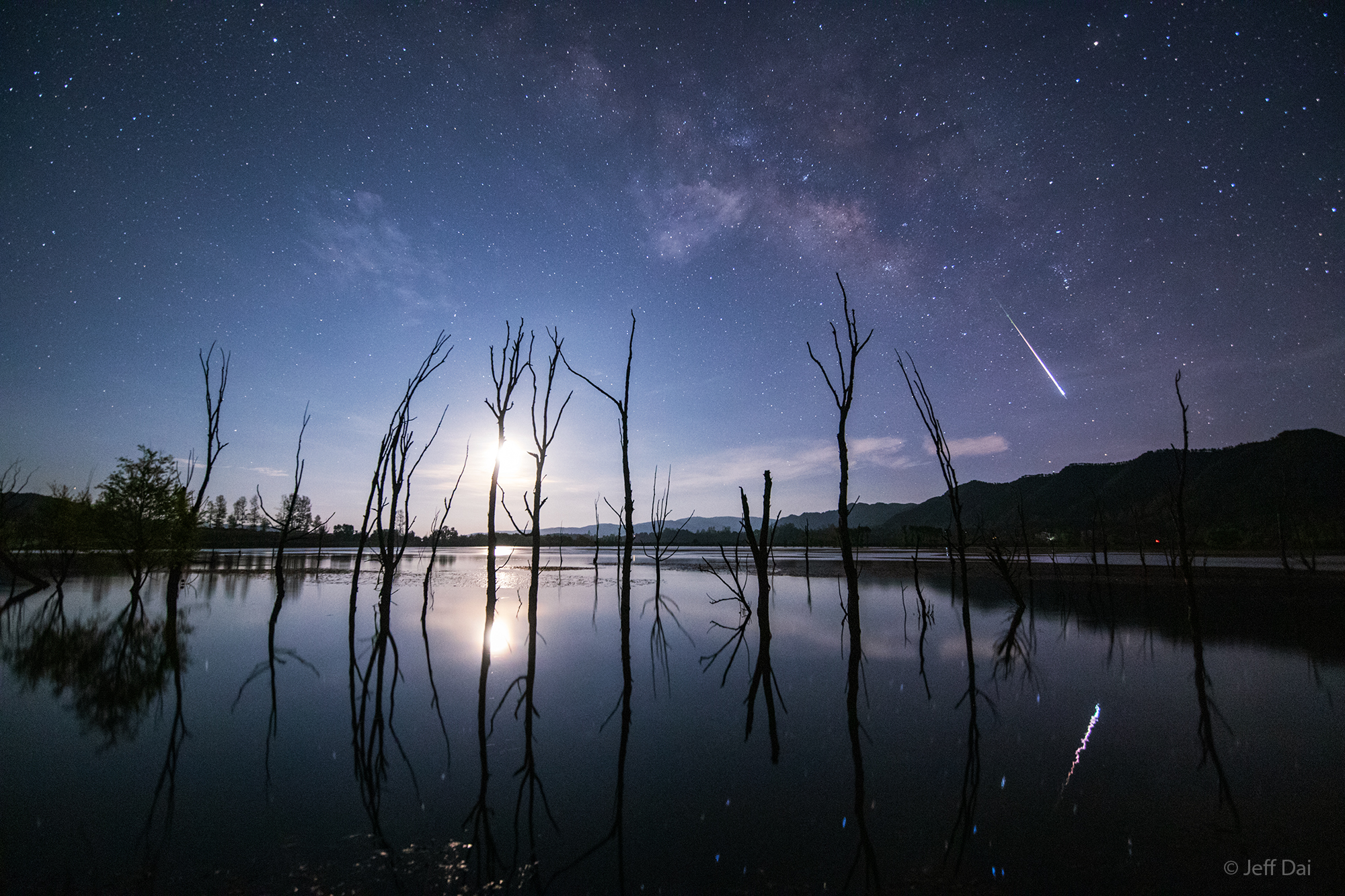
- NASA APOD archive — Lyrid of the Lake (2022), Lyrid Meteors from the Constellation Lyra (2020), Lyrid Meteor Streak (2020), Lyrids in Southern Skies (2017).
- International Meteor Organization — 2026 shower calendar.
- Wikipedia — Lyrids, Comet C/1861 G1 (Thatcher), Meteor shower.
Curious? Try one 👇