

Scientists Just Mapped the Invisible Universe - Here Is What They Found
Scientists Just Mapped the Invisible Universe
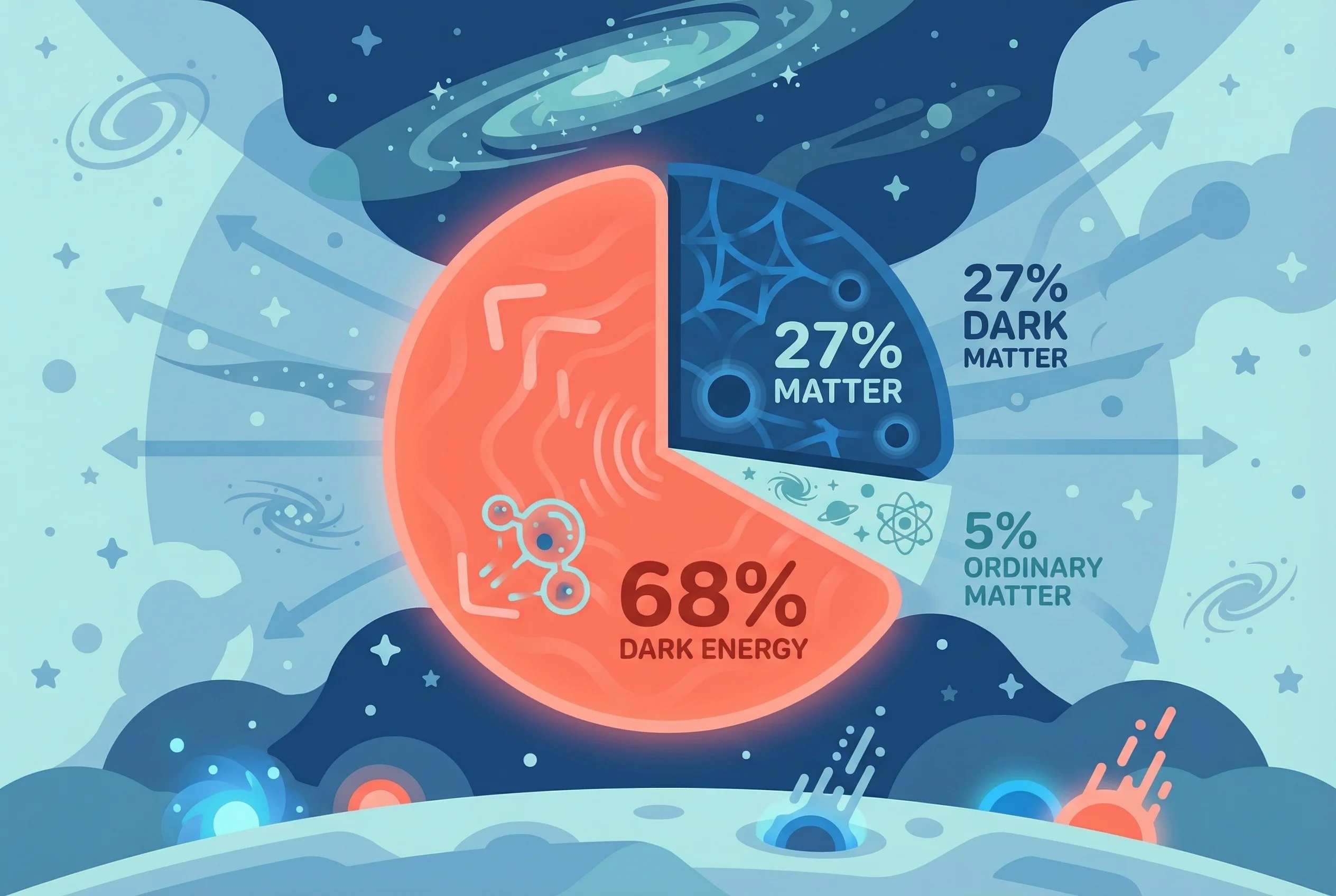
January 2026 - Here is a mind-bending fact: everything you can see - every star, planet, person, and atom - makes up only 15% of the matter in the universe.
The other 85%? It is called dark matter, and we cannot see it. At all.
Yet scientists just created the most detailed map of this invisible stuff ever made. How do you map something you literally cannot see?
The Universe's Ghost
Dark matter is weird. Really weird.
So how do we know it is there?
Gravity.
Dark matter may be invisible, but it still has mass. And mass creates gravity. Scientists can detect dark matter by watching how its gravity affects the things we can see.
Curious? Try one 👇
Why is the sky blue?
Jump into the daily quiz →The Cosmic Magnifying Glass Trick
Here is the clever technique scientists used:
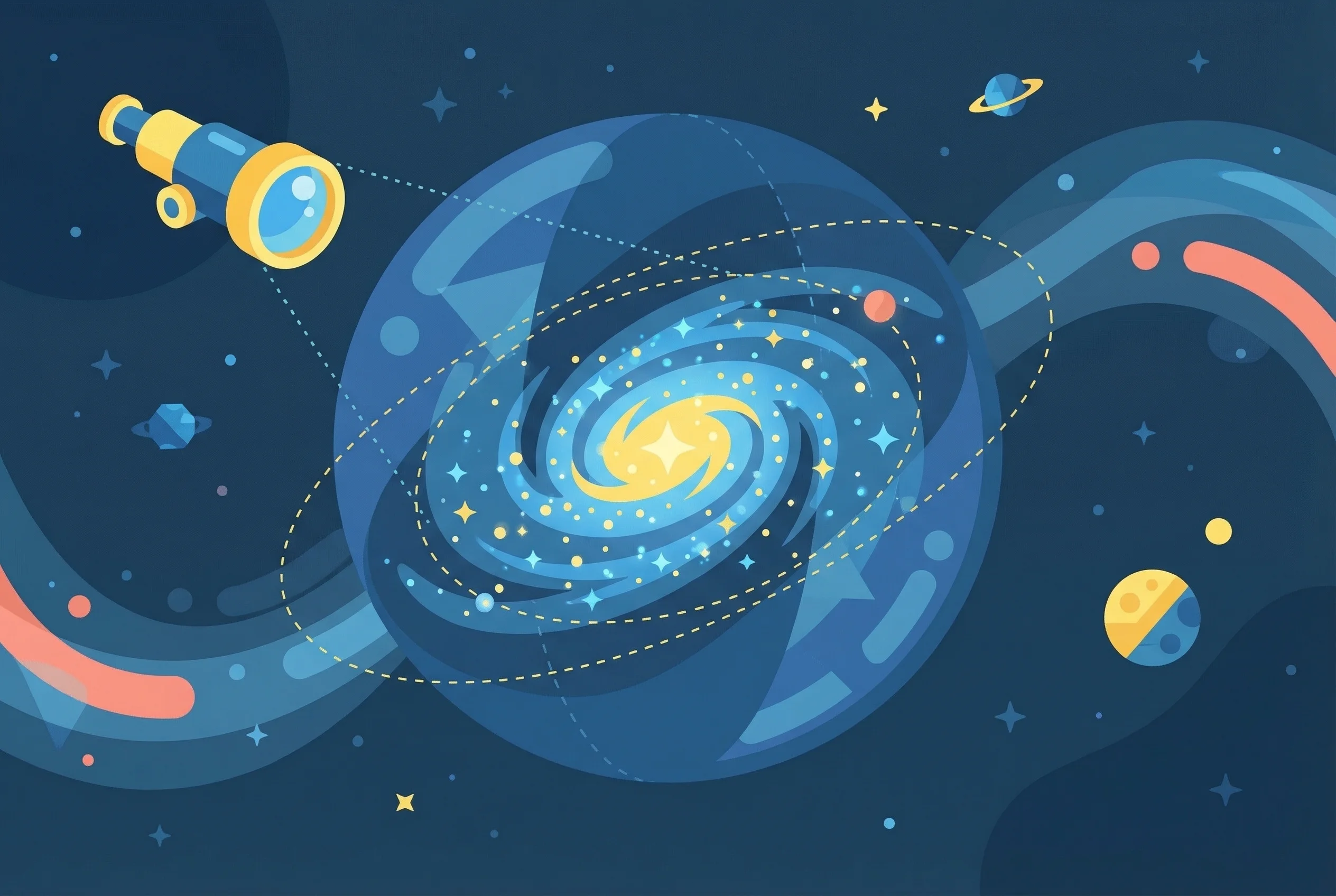
When light from a distant galaxy travels toward Earth, it sometimes passes near clumps of matter (including dark matter). That matter's gravity bends the light, like a cosmic magnifying glass.
This effect is called gravitational lensing. By measuring how the shapes of about 250,000 distant galaxies are slightly distorted, scientists can work backwards to figure out where the invisible dark matter must be.
It is like mapping invisible obstacles by watching how a stream of water bends around them.
The New Map: What We Found
Using NASA's James Webb Space Telescope, scientists created a map covering a patch of sky about 2.5 times larger than the full Moon. Within that patch, they identified nearly 800,000 galaxies - some seen for the first time.
The results?
1. The Cosmic Web Is Real
Dark matter is not spread evenly through space. It forms a massive cosmic web - a network of:
Regular matter (stars, galaxies, us) follows this same pattern. Wherever there is dark matter, there is regular matter too.
2. Dark Matter Came First
The map confirms that dark matter clumped together first, then its gravity pulled regular matter along for the ride. Dark matter is the invisible scaffolding that shaped the entire universe.
3. Without Dark Matter, We Might Not Exist
This map provides stronger evidence that without dark matter, we might not have the elements in our galaxy that allowed life to appear, said JPL astrophysicist Jason Rhodes.
Here is why: Dark matter's gravity helped galaxies form earlier than they would have otherwise. Those early galaxies created the first stars, which forged heavy elements like carbon, oxygen, and iron - the building blocks of planets and life.
Why Can We Not See Dark Matter?
This is one of the biggest mysteries in physics. We know dark matter:
But we have no idea what it actually is.
It does not interact with light or electromagnetic forces. It passes right through ordinary atoms. The leading theory is that it is made of some unknown particle we have not discovered yet.
What Is Next?
NASA's upcoming Nancy Grace Roman Space Telescope will map dark matter across an area 4,400 times bigger than this study. That could finally answer some of the biggest questions:
The Big Picture
Think about this: 85% of everything that exists is completely invisible to us. We only discovered it exists because of its gravitational fingerprints.
And yet this invisible stuff created the conditions for galaxies, stars, planets, and eventually life to exist.
The universe is far stranger than it appears.
---
The full study was published in Nature Astronomy on January 26, 2026.
<div class="mw-keep-reading"><h2>Keep reading</h2><ul><li><a href="/blog/asteroid-2024-yr4-moon-impact-2032">What If an Asteroid Hits the Moon? The 2024 YR4 Story</a></li><li><a href="/blog/life-molecule-thiepine-interstellar-space-2026">Scientists Found a Building Block of Life Floating in Space - 27,000 Light-Years Away</a></li><li><a href="/blog/lyrid-meteor-shower-2026-when-where-how-to-watch">Lyrid Meteor Shower 2026: When, Where, and How to Watch the Peak</a></li><li><a href="/blog/space-trivia-questions-and-answers">Space Trivia Questions and Answers: Cosmic Questions With the Why</a></li><li><a href="/trivia-question-of-the-day">Trivia Question of the Day</a></li></ul></div>
Curious? Try one 👇
Why is the sky blue?
Jump into the daily quiz →
Test Your Knowledge
Want to test what you learned about Space & Astronomy?
Take a quiz on this topic →