

Earth Day 2026: 12 Weird Whys About the Planet You Live On
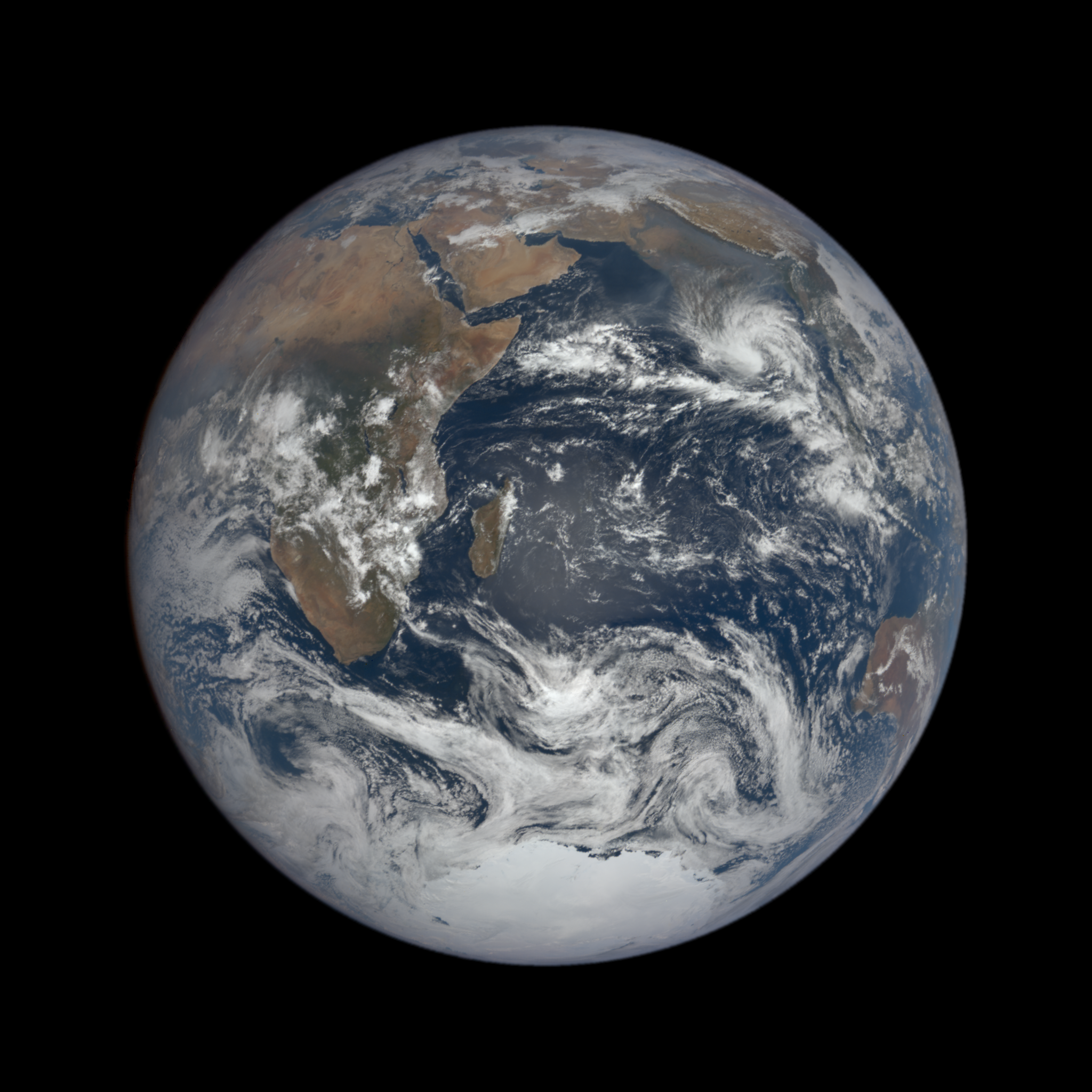
April 22, 2026 — Earth Day
Every Earth Day we hear the same sermon: recycle more, fly less, save the whales. All true, all important. But the planet you’re standing on is also the single weirdest thing in your life — a ball of iron wrapped in slow-moving rock, dragged around the sun at 107,000 km/h, leaking air into space, and literally pulling continents around beneath your feet.
So here are twelve “small whys” about Earth you probably haven’t thought about today. Each one is verifiably true, each one has a mechanism behind it, and each one will change how you look out the window.
TL;DR
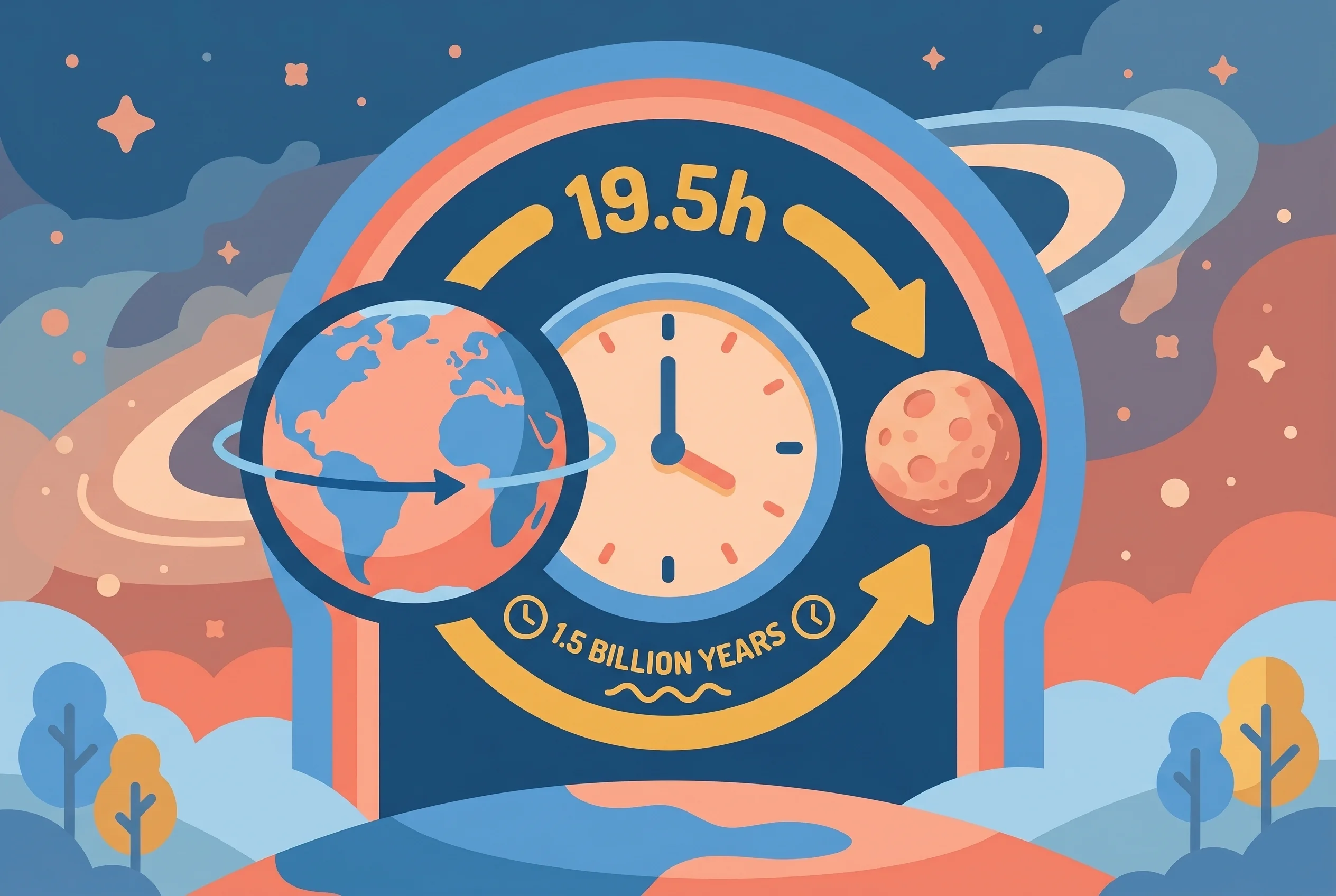
- Earth’s day was stuck at 19.5 hours for 1.5 billion years because the sun and moon were locked in a tidal tug-of-war.
- On July 5, 2024, Earth recorded its shortest day ever since atomic clocks began — and we may soon need our first-ever negative leap second.
- At the equator you weigh 0.5% less than at the poles.
- About half the oxygen you breathe comes from the ocean — phytoplankton, not rainforests.
- Earth’s atmosphere leaks ~90 tonnes/day into space. Mars lost its whole atmosphere that way.
- The Sahara dumps 22,000 tonnes of phosphorus/year into the Amazon — the rainforest runs on desert dust.
- Earth’s magnetic north is racing toward Siberia at 35 km/year.
- Earth is the only planet in English not named after a god — because when the names were assigned, nobody thought Earth was a planet.
- Earth’s inner core is roughly as hot as the surface of the sun.
- The deepest hole ever drilled (Kola, 12.26 km) stopped because the rock was twice as hot as predicted.
- Beneath Tibet, three continent-sized mantle currents meet in a “mantle-wind black hole” — and it’s the reason the Himalayas exist.
Curious? Try one 👇
Why is the sky blue?
Jump into the daily quiz →1. Earth’s day was stuck at 19.5 hours — for 1.5 billion years
You know that the moon is gradually slowing Earth’s rotation. Every century our day gets about 1.8 ms longer, because tidal friction from the moon bleeds rotational energy away. 600 million years ago, a day was about 22 hours. 1.4 billion years ago, about 18 hours. So far, so textbook.
Here’s the part the textbook leaves out. Between roughly 2 billion and 600 million years ago, Earth’s day stopped changing almost completely. It sat at ~19.5 hours for a billion and a half years.
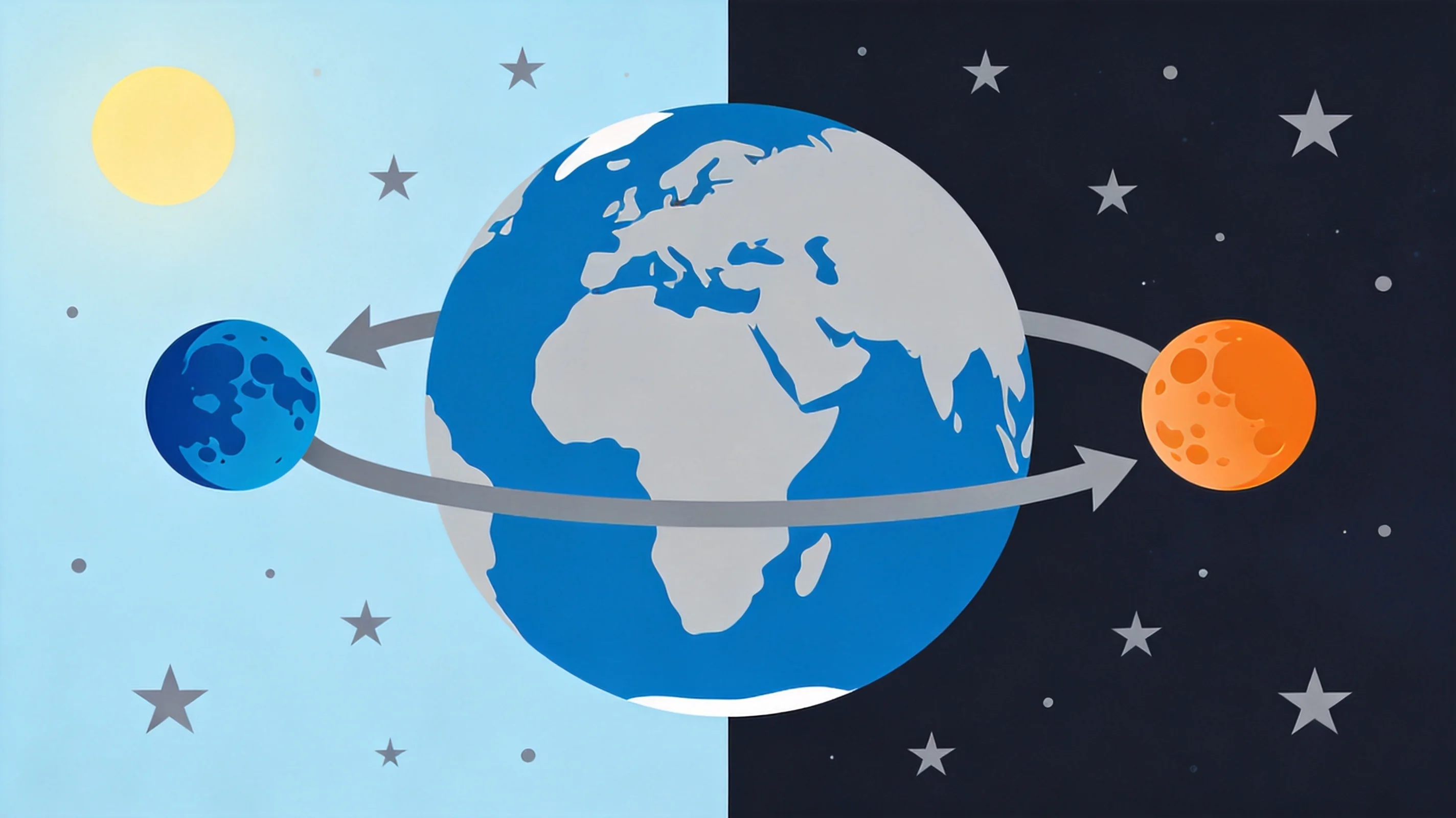
Why? Because there are two tides acting on Earth, not one. The moon pulls on the oceans (the tide you know). The sun pulls on the atmosphere — a much smaller effect, but it works the opposite way. The moon’s ocean tide tries to slow Earth down; the sun’s atmospheric tide, when conditions are right, can actually speed Earth up.
For 1.5 billion years, those two effects almost exactly cancelled. The day got locked. Then, as Earth’s atmosphere cooled, the resonance broke — and the clock started ticking again.
Which means: for most of the time life has existed on Earth, our “day” was a different length than it is now, determined by a balance between two different celestial bodies pulling on two different parts of the planet.
2. The shortest day in history was July 5, 2024
While the long-term trend is a slowing Earth, the short-term trend since 2020 is the opposite. Since atomic clocks started keeping precise time in the 1960s, every record for “shortest day” has been broken in the last five years.
The current record holder is July 5, 2024: Earth completed one rotation 1.66 milliseconds faster than the standard 24-hour day. July 10, 2025 came close, shaving off 1.36 milliseconds.
Nobody fully understands why. Candidate culprits include glacial melt redistributing mass (changing Earth’s moment of inertia), inner-core wobbles, and atmospheric mass shifts. What we do know is that if this keeps up, humanity may soon need to do something that has never been done in history: subtract a leap second from official time. A “negative leap second” would break some systems that were never designed to imagine time running forward faster than the atomic standard.
3. You weigh 0.5% less at the equator than at the North Pole
Not a rounding error. If you weigh 70 kg at the North Pole, you weigh about 350 grams less at the equator — without losing any mass. Pack a scale on your next tropical vacation.
Two effects add up here:
- Centrifugal force (≈70% of the difference). Earth spins once a day. If you’re at the equator, you’re being flung outward at 1,670 km/h. That “flinging” slightly cancels gravity.
- Equatorial bulge (≈30% of the difference). Earth’s spin makes it bulge outward by ~21 km at the equator. You’re farther from the center of mass, so gravity pulls on you a little less.
Sea-level gravity is 9.780 m/s² at the equator and 9.832 m/s² at the poles — a gap Olympic weightlifters secretly think about when meets are held in different cities.
4. Half the oxygen you breathe comes from the ocean, not the rainforest
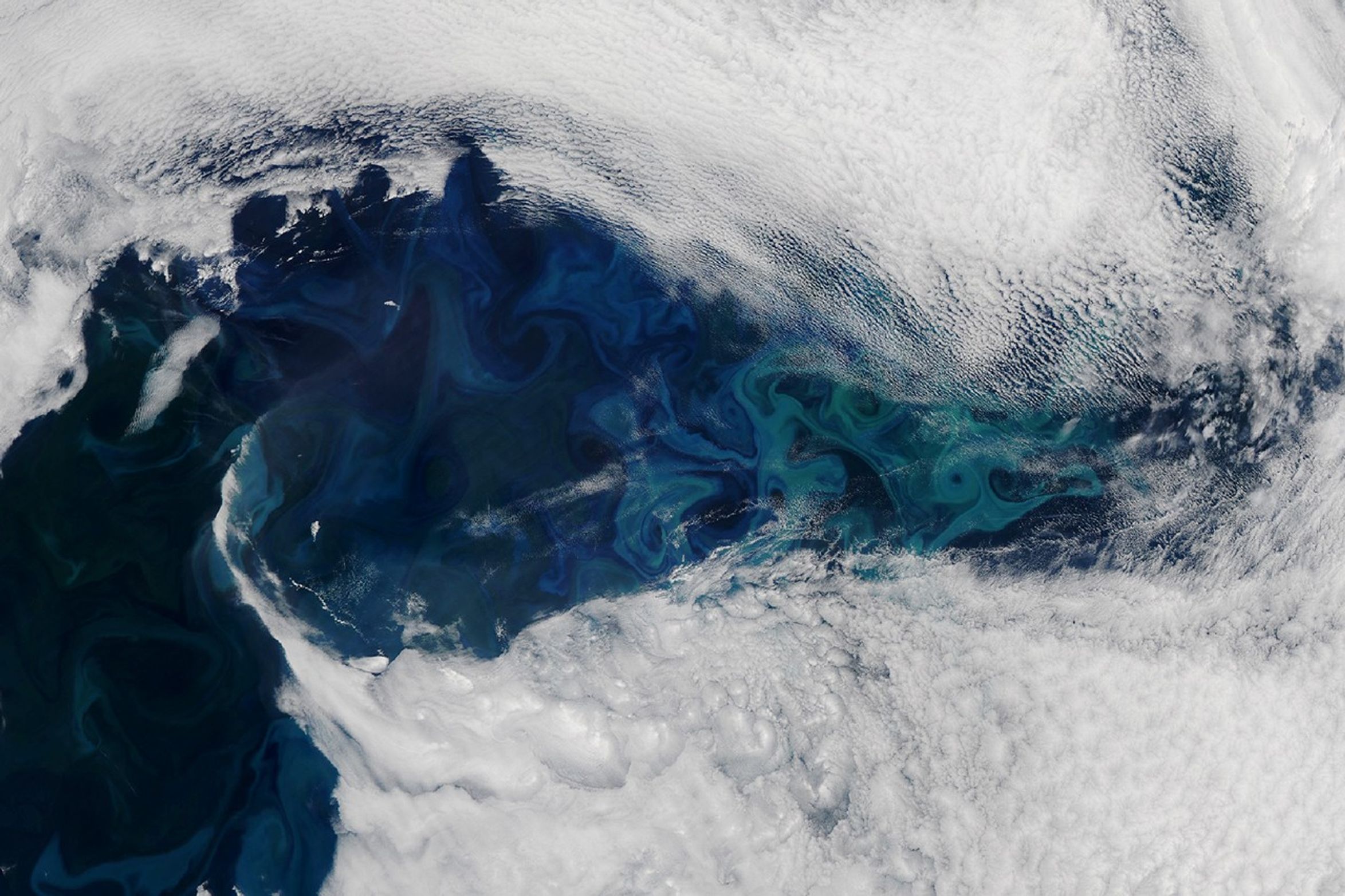
“The Amazon is the lungs of the Earth.” You’ve heard it a thousand times. It’s also mostly wrong.
Scientists estimate that 50–80% of atmospheric oxygen is produced by marine phytoplankton — microscopic algae and cyanobacteria drifting in the top sunlit layer of the ocean. A single genus, Prochlorococcus, is thought to be responsible for up to 20% of all atmospheric oxygen on its own. There are more of these individual cells than there are stars in the observable universe.
Forests also produce a lot of oxygen, but most of it is consumed by the forest itself (respiration, decomposition). The Amazon is roughly net-neutral on oxygen. The ocean, because phytoplankton carbon can sink to the seafloor and get buried, is a long-term net producer.
So the next time you take a breath, one of those molecules probably came from something the size of a dust speck, floating a few meters below the surface of the sea.
5. The invention of photosynthesis took 400 million years to “work”
About 2.7 billion years ago, cyanobacteria evolved the ability to split water molecules using sunlight, releasing oxygen as a waste product. You’d expect atmospheric oxygen to start rising immediately. It didn’t.
For roughly 400 million years, almost all of that new oxygen got absorbed by something else. The early oceans were full of dissolved iron (Fe²⁺), which grabs oxygen the moment it appears and precipitates out as rust. Massive banded iron formations — the source of most of the iron we mine today — are the fossil record of this slow-motion oxygen sponge. Methane in the atmosphere absorbed more.
Only around 2.4 billion years ago, when iron and methane sinks finally saturated, did oxygen start accumulating for real. This is called the Great Oxidation Event, and it was probably Earth’s largest mass extinction: oxygen was toxic to almost all life at the time, which was anaerobic. We are the descendants of the survivors who learned to breathe the pollution.
6. Earth’s atmosphere is leaking — about 90 tonnes a day
Right now, as you read this, Earth is losing about 1 kilogram of atmosphere per second into space. Mostly hydrogen, some helium — the lightest gases, which can sometimes reach escape velocity and break free of Earth’s gravity.
That works out to roughly 90 tonnes per day, or 33,000 tonnes per year. Which sounds apocalyptic until you realize Earth’s atmosphere weighs about 5 × 10¹⁸ kg. At the current leak rate, we’re good for billions of years.
But this is the same process that killed Mars. Mars has weaker gravity and no planetary magnetic field, so its atmosphere leaked much faster, and the solar wind stripped off the rest. Over billions of years a potentially habitable world turned into the freeze-dried desert we see now. Earth is on the same road, just much, much more slowly.
7. The Sahara feeds the Amazon, 22,000 tonnes of phosphorus a year
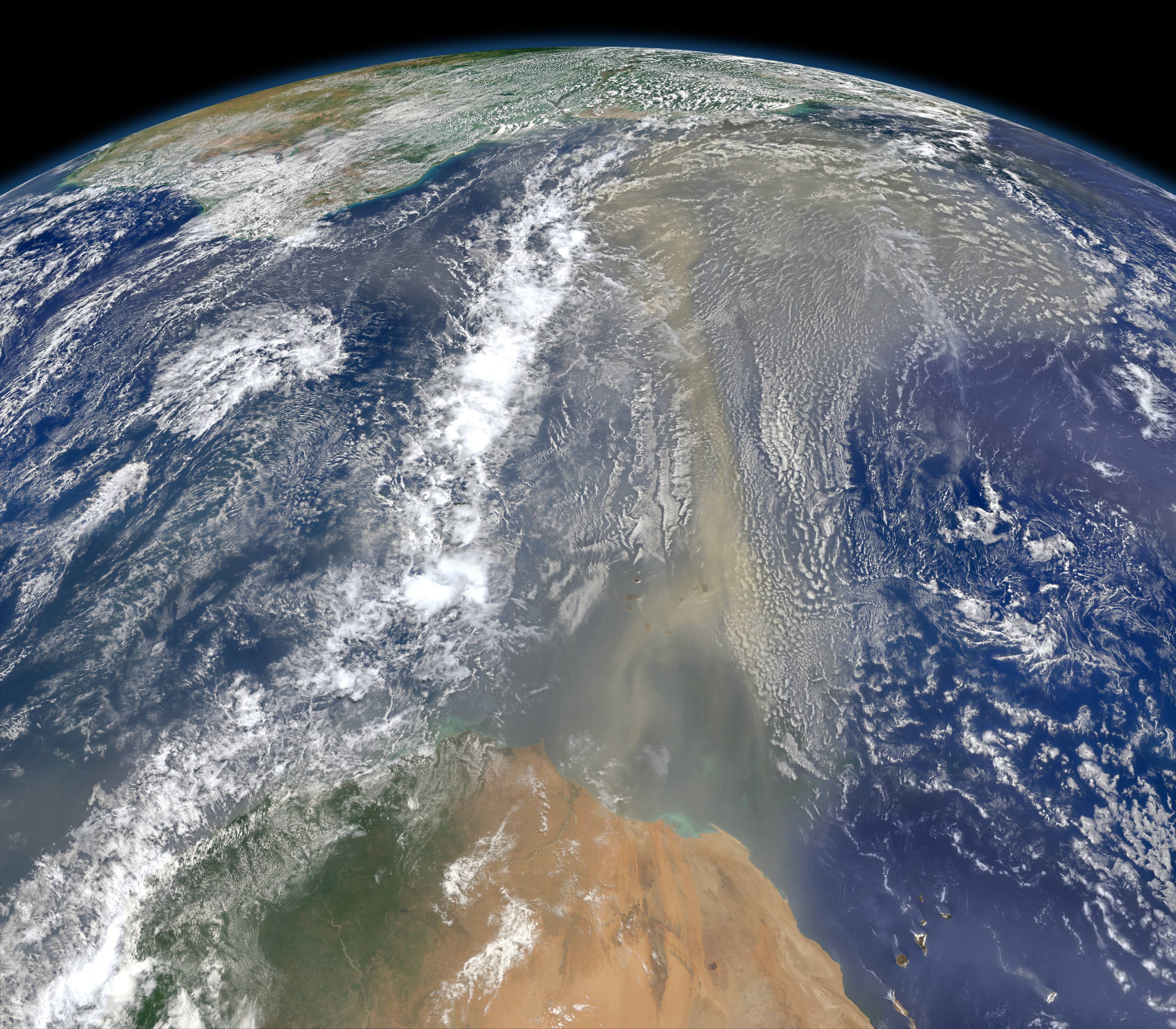
The Amazon rainforest has a problem: its soil is terrible. Tropical rain leaches nutrients away almost as fast as they appear, and phosphorus — essential for life, and impossible for plants to pull out of the air — is constantly being washed into the Atlantic.
So how does the rainforest survive?
Every year, Atlantic trade winds lift 182 million tonnes of dust out of the Sahara — specifically from a dried-up prehistoric lake bed in Chad called the Bodélé Depression, which sits on ancient sedimentary layers rich in mineral nutrients. About 27.7 million tonnes of that dust settles over the Amazon basin each year, and it carries roughly 22,000 tonnes of phosphorus — almost exactly the amount the rainforest loses to runoff.
In other words, the Amazon is quietly being fertilized by a desert 7,000 kilometers away, using a conveyor belt of wind, across an entire ocean. The world’s largest rainforest is propped up by the world’s largest desert.
8. Magnetic north is running toward Siberia at 35 km/year

Magnetic north is not geographic north. It’s the point where Earth’s magnetic field dives straight down into the ground, and it’s generated by churning liquid iron in the outer core. Unlike the geographic pole, it moves.
Throughout the 20th century, magnetic north drifted lazily across northern Canada at about 10 km/year. Then around 1990 it started accelerating — peaking at roughly 60 km/year in the mid-2010s — and aimed itself straight at Siberia. It’s now crossed the prime meridian into the Eastern Hemisphere, and in the 2025 update to the World Magnetic Model, NOAA/BGS reported it has started decelerating to about 35 km/year.
This isn’t just a compass curiosity. Every aviation chart, every GPS-backed phone, every naval navigation system relies on a model of the magnetic field that has to be updated every few years to keep up. When the drift accelerated in the mid-2010s, the WMM had to be updated a year ahead of schedule. Somewhere deep beneath Canada and Siberia, currents of molten iron are rearranging themselves, and the whole planet’s navigation infrastructure has to adjust.
9. Earth is the only planet in English not named after a god
Mercury, Venus, Mars, Jupiter, Saturn, Uranus, Neptune. Greek and Roman gods, every one. Then there’s Earth — the Old English word eorþe, meaning “ground” or “dirt.”
Why the odd one out? Because for most of history, Earth wasn’t considered a planet. Before Copernicus, “planet” meant “wandering star” — one of the points of light in the sky that moved against the fixed stars. Earth was the stationary floor of the universe, not a wandering light. By the time the heliocentric model took hold in the 1500s and it became clear that Earth was just another world, the naming convention had been set in stone for a couple of thousand years. We kept the dirt word.
You live on the only “wanderer” still named after its own mud.
10. Earth’s inner core is as hot as the surface of the sun
The solid iron inner core of Earth sits at around 5,400 °C. The photosphere of the sun, which is what we see as the sun’s “surface,” sits at around 5,500 °C.
A sphere of iron and nickel the size of the moon, hidden 5,100 km beneath our feet, is within 100 degrees of the temperature of a star.
Most of that heat is primordial — left over from the violent formation of Earth 4.5 billion years ago, when a Mars-sized body slammed into the proto-Earth. A significant chunk (somewhere between 20% and 50%, depending on the study) comes from the ongoing radioactive decay of uranium, thorium, and potassium-40 scattered through the mantle. In a very literal sense, Earth is a slowly cooling nuclear reactor with a crust on top.
11. The deepest hole ever drilled gave up because the rock got too hot to drill
In 1970, Soviet scientists started drilling a hole on the Kola Peninsula. The goal was simple and ambitious: drill as deep as physically possible. They stopped in 1992, at 12,262 meters.
Why? Their model predicted the rock at that depth would be around 100 °C. It turned out to be 180 °C — nearly twice as hot. At those temperatures, the drill bit kept softening, and the rock itself became plastic, flowing back into the hole between drilling sessions. They were still in the crust. The crust is about 35 km thick on average. They got about a third of the way through it.
The entire planet, from where you’re sitting, is roughly 6,400 km to the center. Kola got 12.3 km down. Scaled to an apple: the deepest humans have ever gone is still within the skin.
12. A continent-scale “mantle-wind” black hole sits beneath Tibet
This is the deepest weirdness on the list, and the one that’s newest in the scientific literature — so bear with me for a paragraph more than the others.
The standard story of plate tectonics is that Earth’s outer shell is broken into rigid plates, and those plates drift at a few centimeters per year, carried along by slow convection in the mantle beneath them. In this story the mantle is a passive escalator. The plates ride it.
It turns out the mantle isn’t that polite. In many places, especially under the Pacific and under major continental collisions, mantle currents move faster than the plates above them — up to 10+ centimeters per year — and they actively drag plates around rather than just carrying them.
The Tibetan Plateau is the most dramatic example on Earth. A 2024 paper in Nature Communications shows that beneath Tibet, three hemisphere-scale mantle currents converge: one coming from the Mongolia/Europe direction, one from the Pacific, and — most aggressively — one surging up from beneath the Indian Ocean. The paper calls this Indian-Ocean current the “mantle wind.”

What makes it unusually fierce is the geometry of what’s beneath the Indian Ocean. When the Indian subcontinent began slamming into Asia around 50 million years ago, it tore the old oceanic lithosphere apart. Normally, plates fight back against mantle flow by pushing against one another, which lets pressure build up and stay distributed across a hemisphere. Here, the tear gave the mantle flow a single gaping escape route, and the pressure difference of an entire half of the planet focused itself into that wound, jetting northward into Tibet.
Crucially, this is not “slab pull” — the usual textbook explanation for what drives plates, where a sinking chunk of oceanic crust acts like an anchor dragging the rest of the plate down with it. You can’t see a continuous sinking slab here. It’s mantle-driven, top-down: a powerful current of hot, ductile rock in the deep mantle is dragging the root of the Indian plate and piling crust vertically into the Himalayas and the plateau.
The simplest way to picture it is as a mantle-flow black hole: a single convergence zone, hundreds of kilometers deep, that’s sucking material in from three directions at once. The result, five kilometers above your head if you’re standing in Lhasa, is the highest plateau on Earth. The reason Tibet is the roof of the world isn’t primarily because India pushed up — it’s because the whole planet, on one side, is being pulled sideways into that hole.
You walk on continents. The continents are being steered by rivers you’ll never see.
FAQ
When is Earth Day?
April 22 every year. It was first observed on April 22, 1970, founded by U.S. Senator Gaylord Nelson as a response to the 1969 Santa Barbara oil spill, and has grown into one of the most-observed civic events in the world.
Is Earth really spinning faster?
Yes, on short timescales. On the long timescale (billions of years), the moon is slowing Earth’s rotation by about 1.8 ms per century. But since ~2020, short-term variations (inner-core coupling, glacial mass redistribution, atmospheric changes) have dominated, and Earth has actually been rotating slightly faster than the atomic-clock standard on many days.
Will magnetic north actually reach Siberia?
It’s already east of the prime meridian. Whether it continues deep into Russia or turns around depends on flow patterns in the outer core that we can’t yet predict beyond a few years. The field itself also goes through occasional reversals (north and south swapping); the last one was about 780,000 years ago.
How much of my oxygen actually comes from the ocean?
Estimates range from 50% to 85%, with most textbooks citing “about half.” The honest answer is that it’s hard to measure precisely — phytoplankton populations fluctuate seasonally — but at a minimum one in every two breaths you take came from something that lives in the sea.
What does any of this have to do with AIgneous Million Whys?
AIgneous Million Whys is a micro-learning app for exactly this shape of knowledge — the kind you wouldn’t normally search for, but that quietly upgrades how you see the world. Why is Tibet so high? Why does magnetic north drift? Why is the Amazon fertilized by a desert? These are “small whys” — phenomena almost everyone has heard of, wrapped around mechanisms almost nobody has thought carefully about. We believe fun knowledge like this shouldn’t require cracking open a textbook. Small whys matter — and the best way to learn them is in small, everyday moments, 10 seconds at a time. Try the daily quiz →
Sources & further reading
- Mitchell, R. & Kirscher, U., “Mid-Proterozoic day length stalled by tidal resonance,” Science Advances, 2023. (On the 19.5-hour day.)
- International Earth Rotation Service (IERS) length-of-day data, 2020–2025. (Shortest-day records.)
- NASA Earth Observatory: “How Much Oxygen Comes from the Ocean?” and “Oxygen Factories in the Southern Ocean.”
- Lyons, T. W. et al., “The rise of oxygen in Earth’s early ocean and atmosphere,” Nature, 2014. (Great Oxidation Event.)
- ESA Cluster mission: “The curious case of Earth’s leaking atmosphere.”
- Yu, H. et al., “The fertilizing role of African dust in the Amazon rainforest,” NASA / GRL, 2015.
- NOAA/BGS World Magnetic Model, 2025 Annual Report.
- Chudinovskikh, L. & Boehler, R., “Melting of iron at Earth’s inner core boundary,” Nature, 2001.
- Kozlovsky, Y. A., The Superdeep Well of the Kola Peninsula, 1987.
- Li, Y. et al., “Cenozoic India–Asia collision driven by mantle dragging the cratonic root,” Nature Communications, 2024. (On the mantle wind beneath Tibet.)
Curious? Try one 👇
Why is the sky blue?
Jump into the daily quiz →Keep Exploring
Related Posts
Fun Facts About the Earth: Why It Never Sits Still
Fun facts about the earth: why Earth bulges, moves plates, shifts its magnetic field, loses air, trades tides with the Moon, and stays hot inside.
Fun Fact of the Day: Trivia Questions & Answers
A new fun fact of the day, the fun way: surprising trivia about animals, space, the human body, food and weather — tap each card to reveal the answer and why.
Weird Facts That Sound Fake But Are True
Weird facts that sound fake but are true, explained through quick science, nature, food, space, history, and everyday mystery cards you can actually play.